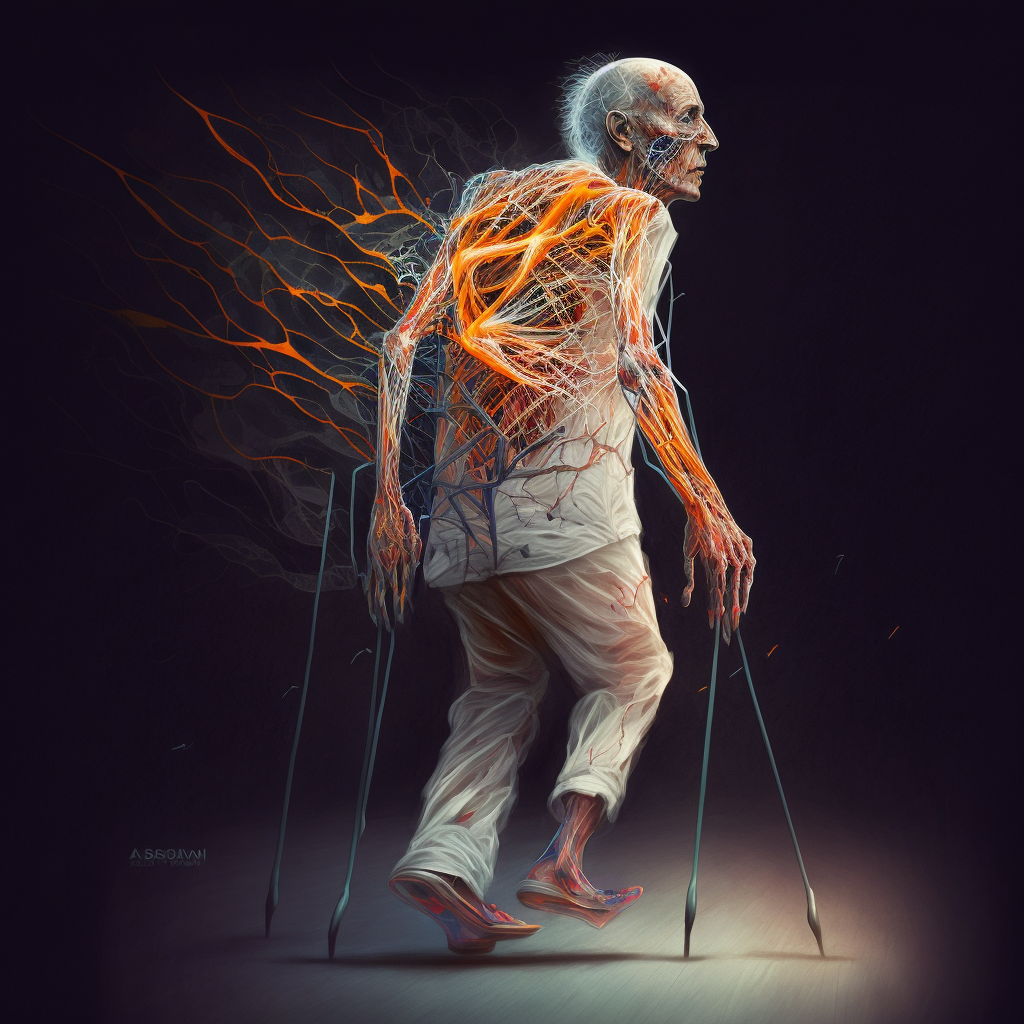
Guillain-Barré syndrome (GBS) is a rare disorder in which the body’s immune system attacks the nerves, leading to weakness or paralysis of the limbs, face, and breathing muscles. The cause of GBS is not well understood, but it is often preceded by an infection, such as a respiratory or gastrointestinal illness.
Symptoms of GBS typically begin with tingling or numbness in the fingers and toes, which spreads to the limbs and eventually to the trunk. As the disorder progresses, muscle weakness and paralysis may occur, making it difficult or impossible to move. In some cases, the disorder can also affect the cranial nerves, leading to problems with vision, hearing, and speech.
The thymus gland is an organ located in the chest that plays a role in the immune system. It is responsible for the production and maturation of T-lymphocytes, also known as T-cells, which are a type of white blood cell that play a critical role in the body’s immune response.
The exact role of the thymus gland in the development of Guillain-Barré syndrome (GBS) is not well understood. However, some studies suggest that the thymus gland may play a role in the regulation of the immune response in GBS.
Research has shown that individuals with GBS have an increased number of T-cells in the blood, which suggests that the thymus gland may be overactive in GBS. Additionally, some studies have found that individuals with GBS have higher levels of certain immune markers in the thymus gland, which suggests that the thymus gland may be involved in the development of GBS.
The diagnosis of GBS is based on the patient’s symptoms, a physical examination, and nerve conduction studies. Treatment typically involves supportive care, such as physical therapy and occupational therapy, to help the patient regain strength and function. In extreme cases, the patient may need mechanical ventilation to help them breathe.
Intravenous immunoglobulin (IVIG) therapy is the most commonly used treatment for GBS. IVIG therapy is a treatment that is given through a vein (intravenously) and is composed of antibodies from healthy people. The antibodies can help stop inflammation and damage to the nerves. Plasmapheresis, which is similar to IVIG therapy, is a procedure that removes abnormal antibodies from the blood.
The prognosis for GBS varies depending on the severity of the disorder and the speed of treatment. In most cases, patients recover fully or have only mild residual weakness. However, in some cases, the disorder can lead to permanent nerve damage and disability.
Guillain-Barré syndrome is a rare disorder in which the body’s immune system attacks the nerves, leading to weakness or paralysis of the limbs, face, and breathing muscles. The cause of GBS is not well understood, and the symptoms can vary widely. Treatment typically involves supportive care, and in severe cases, the patient may require mechanical ventilation to assist with breathing. IVIG therapy is the most common treatment for GBS, and prognosis varies with disorder severity and treatment speed. However, in some cases, the disorder can lead to permanent nerve damage and disability.

I was treated for GBS in 2007, with IVIG, exactly as described here. It was fall, I woke up and went to get out of bed. I swung my legs over the side of the bed, put my feet on the ground, and when I went to stand up I fell right over. My legs did not work from below the knees down. Later, I remembered that days before, I had been massaging my feet, ankles, and legs while watching tv. Which isn’t that unusual, except at that time I hadn’t done that regularly, or really ever. A year before, I had severely hurt my ankle and did not go to the doctor for treatment. A year after the initial ankle injury, I had decreased mobility on that leg and ankle after prolonged periods of standing and walking. I found a surgeon who would repair my ankle, or at least vacuum out the ligament debris floating around. They did, and I was advised I could go back to work the next day, which I did. It was a month later that I woke up with paralysis. That day I was subjected to a spinal tap, which was another odd experience in itself. The initial doctor was a student and just couldn’t get it. The third doctor that attempted, did get it. Which was probably due to my positive encouragement. Literally, telling them that “we’ve got this”, and “you can do it.” In recent years, I have been made aware of three people out of all the people I’ve known in my life, three and two I only know second hand (I’ve never met them) that have been diagnosed with GBS. One of them was also diagnosed with “Chronic Inflammatory Demyelinating Polyneuropathy (CIDP)” which I’m told there is a foundation for both, now.
Prior to the GBS diagnosis, several years before I was diagnosed with Mono, and later in a separate instance Chronic Fatigue Syndrome. At the time when I was diagnosed with GBS I was working my 9-5, another job on evenings and weekends, and trying to keep up a social life. The best I have figured is that I had just worn myself out, making my body susceptible to injury. That the thymus would have something to do with all of this makes good sense to me (a lay-person), given the way GBS was described to me at the time-that my immune system started killing off my peripheral nervous system.
I recently started to track down my medical records from that period, will be interesting if any blood work is available for review.