Credential, Lineage, and the Social Economy of Alphabet Therapies
Within many contemporary “alphabet therapies”, i.e., training-led psychological and therapeutic modalities characterised by proprietary techniques, charismatic founders, and intensive workshop cultures, professional life is shaped as much by social hierarchy as by technical skill. Alongside the stated goal of learning methods, practitioners are often engaged in a parallel process: the negotiation of status.
Here, I want to outline how status operates within such environments. Rather than focusing on extreme cases or overt misconduct, we shall explore the everyday micro-dynamics through which legitimacy, authority, and belonging are established and defended. These dynamics quietly influence what is learned, who is believed, and how ethical boundaries are understood. Of course, I’m completely biased, a heretic, an outlier who’s got it all wrong, and no one really behaves like this. Or do they?
Status Games and Social Hierarchy
A “status game” refers to patterned social behaviour through which relative rank is signalled, contested, and stabilised. In professional training cultures, status games typically involve:
- Claims of experience, seniority, or insider access
- Control over what counts as legitimate knowledge
- Boundary-setting around who belongs and who does not (in-group dynamics)
- Reframing uncertainty or disagreement as a personal deficiency
Status games are not merely individual vanity. They emerge wherever authority is personalised, expertise is difficult to independently verify, and access to knowledge is tiered or monetised. Over time, they can replace careful evaluation with performative confidence and loyalty.
Training Cultures as Social Systems
tl;dr: Basically, most of them are little more than cults.
Training environments function as social systems, not just educational ones. Participants learn not only techniques, but also how to speak, whom to defer to, and which opinions are safe to express. This “hidden curriculum” is rarely explicit, yet it strongly shapes professional identity.
In such systems, learning is inseparable from reputation. Advancement often depends less on demonstrable outcomes and more on visible alignment with accepted figures, narratives, and stylistic norms.
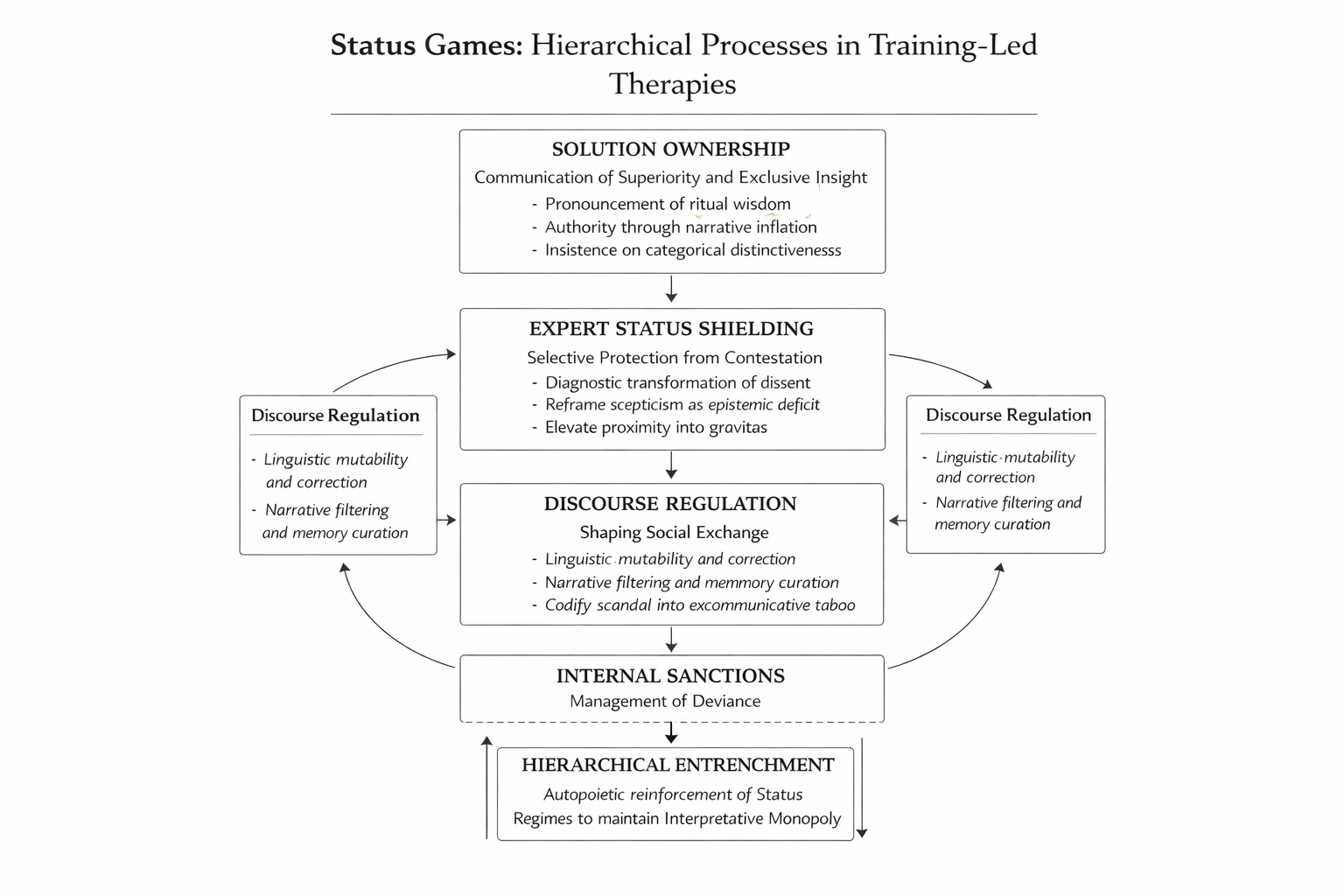
Status Currencies
Status is accumulated and exchanged through recognisable social tokens. Several recur across training-based modalities.
Seniority and novelty
Longevity (“I trained decades ago”) and modernity (“this is the updated version”) both function as legitimacy claims. Practitioners often shift between these positions depending on which confers a higher rank in a given context.
Proximity to prestige
Access to well-known trainers, i.e., private sessions, on-stage demonstrations, and informal familiarity, operates as borrowed authority. Prestige becomes transmissible merely through contact rather than earned through practice quality or ethical consistency.
Credential inflation
As courses proliferate, titles lose discriminative value. Status competition escalates through repeated trainings, exclusivity claims, or alignment with multiple camps, reinforcing hierarchy rather than clarity.
Linguistic markers
Specialised jargon, first-name references, and unexplained shorthand signal insider status. Fluency is easily mistaken for competence, particularly by newcomers lacking alternative evaluation criteria.
Lineage, Authenticity, and Trainer Politics
Many training cultures place heavy emphasis on lineage: who trained with whom, which version of a method is “authentic”, and which figures are quietly disavowed. Personal disputes are frequently reframed as technical or ethical judgements, allowing social alliances to appear principled.
Lineage politics simplify complex questions of efficacy and responsibility. They also transform loyalty into identity, making critical reflection psychologically and socially costly.
Epistemic Authority and Knowledge Control
Gatekeeping knowledge
Knowledge obtained through independent reading, experimentation, or cross-disciplinary learning is often devalued in favour of sanctioned training experiences. This preserves revenue streams and centralises interpretive authority.
Pathologising disagreement
Resistance, scepticism, or boundary-setting may be reinterpreted as psychological “patterns” or character flaws. This manoeuvre neutralises dissent without addressing its substance, protecting hierarchy by redefining disagreement as deficiency.
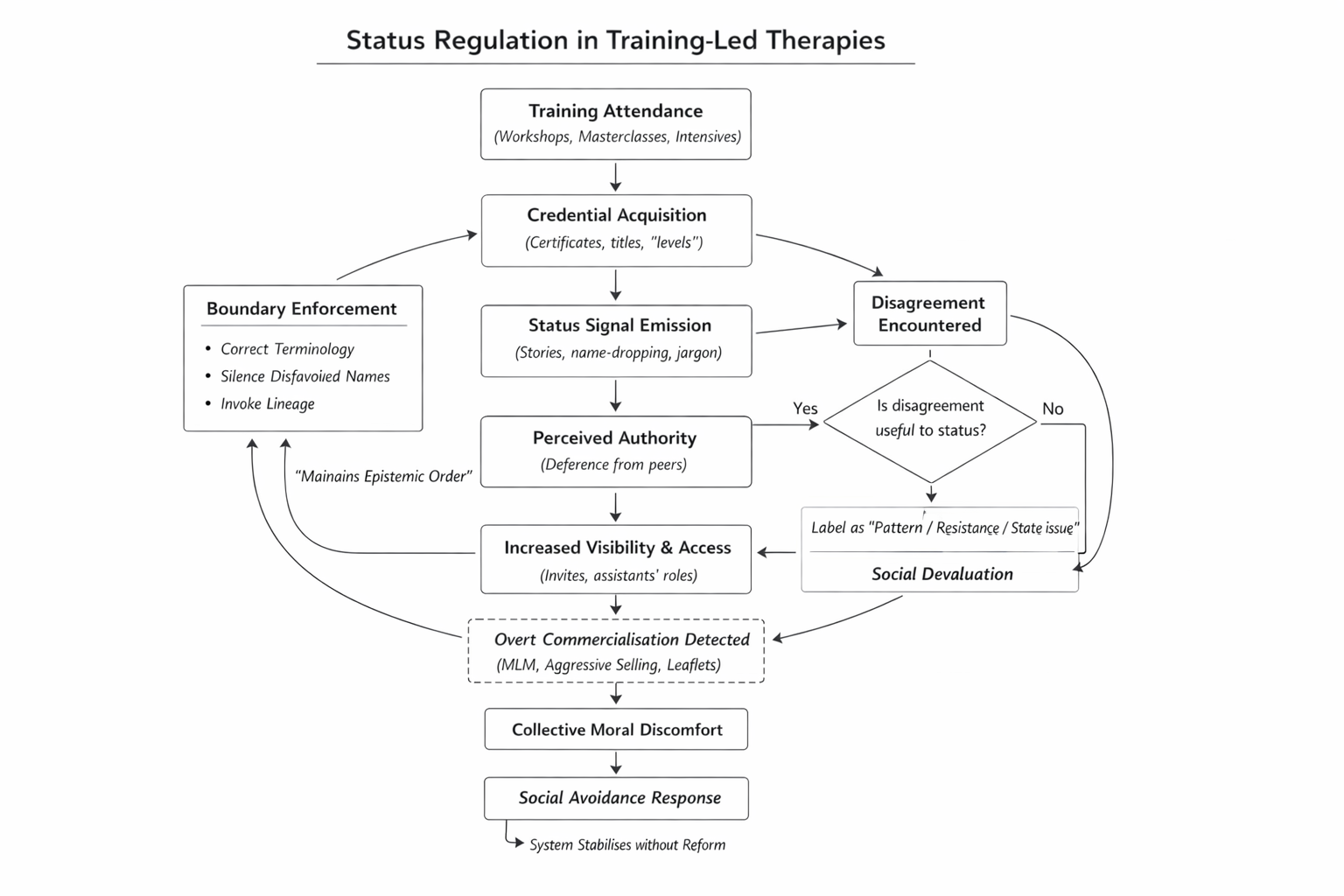
Rituals of Belonging and Exclusion
Communities maintain cohesion through ritualised language, shared assumptions, and informal policing of norms. Mockery of novices, corrective jargon, and knowing glances reinforce group identity while discouraging questioning.
Language thus becomes both a bonding mechanism and a gate: those who speak fluently belong; those who do not are marked as untrained or unreliable.
Policing Dissent and Social Erasure
When individuals fall out of favour, they may be quietly erased from collective memory (I was once told, no, I was warned, “We don’t talk about Steve anymore” after the trainer voiced how much he didn’t like Steve).
Once a person is sanctioned, topics associated with them become unspeakable, and curiosity about them is framed as dangerous. Such practices encourage self-censorship and distort collective understanding.
Over time, silence replaces reflection, and conformity becomes a survival strategy.
Consequences for Practice and Clients
Performative learning
Learning becomes oriented toward signalling competence rather than developing it, reducing space for uncertainty and reflective practice.
Confidence over calibration
Exaggerated certainty is rewarded, while caution, referral, and ethical restraint are undervalued.
Risk to clients
Coercive conversational techniques and diagnostic dismissals can translate into subtle boundary violations within therapeutic work.
Professional credibility
Fields dominated by visible status games struggle to earn trust from clients, regulators, and adjacent professions.
Professional Safeguards
- Distinguish demonstrable skill from borrowed prestige
- Prefer operational evidence over narrative authority
- Treat pathologised disagreement as a warning sign
- Maintain diverse learning sources, including supervision and peer consultation
- Track incentives created by financial and status structures
Status is an unavoidable feature of human groups. The problem arises when status substitutes for evidence, ethics, and accountability. In training-led therapeutic cultures, unexamined hierarchies quietly shape what can be said, learned, and questioned.
A mature professional field does not eliminate status but constrains its influence. It creates structures where competence is demonstrable, disagreement is safe, and authority is accountable. Without such constraints, status games cease to be social background noise and become the organising principle of practice itself.

This seems to be at the heart of “purity culture” and coming up against, disagreeing, or even questioning these people result in “getting schooled” really quickly.