An Academic and Ethical Examination of Status Inflation in the Therapeutic Marketplace
Within the loosely regulated landscape of hypnotherapy and related “alphabet therapies,” the inflation of professional status through fabricated or misleading academic credentials has become a persistent ethical concern. This article critically examines the phenomenon of fake doctorates, mail-order PhDs, and ambiguous professional titles, situating them within broader issues of credibility, professional identity, and practitioner motivation. Credential misuse undermines public trust and reveals underlying status-driven dynamics within certain sectors of the therapeutic marketplace.
Introduction: The Emergence of Credential Skepticism
Several years ago, a now-defunct blog circulated widely online cataloguing individuals within hypnosis and related fields who publicly claimed doctoral titles without holding recognised university doctorates. Although the original site has since disappeared, archived versions remain accessible via the Internet Archive, allowing retrospective examination of its claims.
What was striking was not merely the existence of fraudulent credentials but the sheer scale of the issue. Many practitioners who were widely assumed, by clients and peers alike, to be medically or academically qualified were revealed to hold no such credentials. This discovery challenged naïve assumptions about professional legitimacy in unregulated or lightly regulated therapeutic domains.
Mail-Order Doctorates and Credential Laundering
A common mechanism underpinning false credential claims is the so-called mail-order doctorate. These typically involve institutions exploiting loopholes in international accreditation systems, often registered in jurisdictions with minimal oversight. In exchange for a fee and the submission of non-assessed material, recipients are awarded a “PhD,” frequently in divinity or similarly broad disciplines, without undertaking supervised research or formal academic training.
From a scholarly perspective, these qualifications fail to meet every defining criterion of a doctoral degree: originality, peer review, methodological rigour, and institutional accountability. Yet when presented in marketing materials, the distinction between a legitimate doctorate and a purchased credential is rarely made explicit.
Ambiguous Doctorates and the Chiropractic Example
Another recurrent source of confusion arises from professional doctorates, particularly the Doctor of Chiropractic (DC). While chiropractors may legitimately use this title within their professional scope, problems emerge when the designation is repurposed to imply expertise in unrelated domains such as immunology, vaccination science, or neurodevelopmental disorders.
The ethical issue here is not the qualification itself, but its strategic ambiguity. The public often interprets the honorific “Dr” as synonymous with medical or academic authority, despite the historical reality that the doctorate originated in medieval universities long before its adoption by the medical profession.
Patterns Within Hypnotherapy and “Alphabet Therapies” (NLP, CBT, EMDR, IEMT, PLR, etc.)
Within hypnotherapy, coaching, and other alphabet-labelled modalities, the accumulation of titles and post-nominal letters has become a conspicuous marketing strategy. Websites frequently display long strings of abbreviations that denote privately issued certificates rather than externally validated qualifications.
From an academic standpoint, this practice represents symbolic credentialism: the construction of authority through appearance rather than demonstrable competence. Notably, individuals holding genuine university PhDs, particularly in psychology or neuroscience, rarely insist on using the title ‘Doctor’ in everyday professional interactions. The insistence on titles, therefore, often becomes an informative behavioural signal rather than a marker of expertise.
Professional Identity, Status, and Motivation
At a deeper level, the misuse of credentials reveals something about practitioner motivation. Therapy, at its core, is a conversational profession, one human being working with another through structured dialogue and relational skill, or at least one may hope. When exaggerated titles are used to elevate social status, the focus subtly shifts from client welfare to practitioner validation.
This dynamic raises an important ethical question:
Is the practitioner serving the client or using the client relationship to fulfil personal needs for importance, authority, or admiration?
Academic ethics frameworks consistently emphasise transparency, proportionality of claims, and avoidance of deception. Credential inflation runs counter to all three.
Whistleblowing, Professional Defensiveness, and Cultural Parallels
When false credentials are publicly challenged, the response is often defensive. It is the critics themselves who are accused of “bringing the profession into disrepute”, a reaction that mirrors well-documented patterns in institutional whistleblowing. The paradox is familiar: exposing misconduct is framed as more damaging than the misconduct itself. It’s undoubtedly a form of institutional gaslighting.
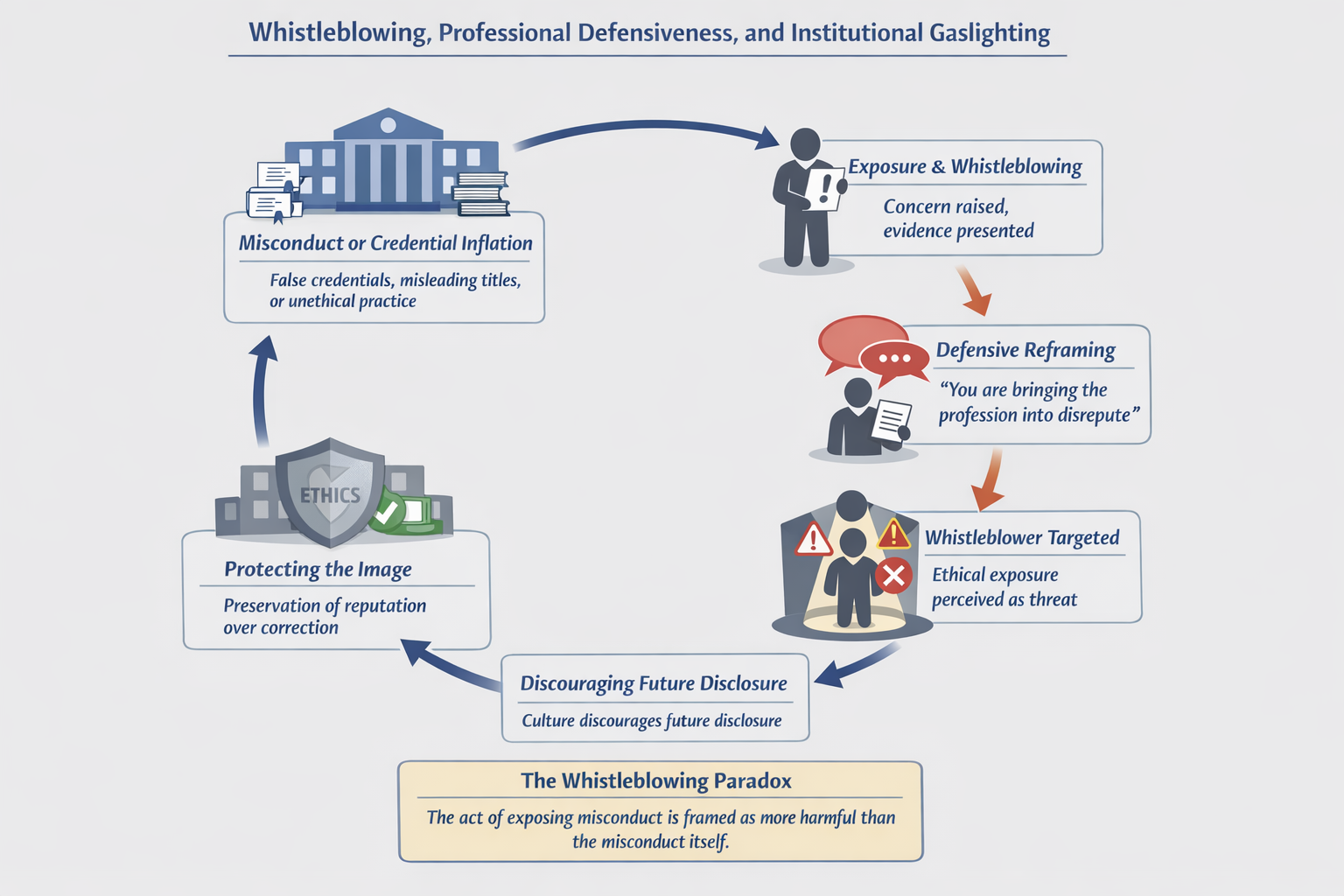
This cultural reflex has been observed across healthcare systems, including large public institutions, and appears equally entrenched within unregulated therapeutic communities. The preservation of the collective image is prioritised over ethical self-correction.
Toward Descriptive Honesty
To be clear, professional self-description is not inherently unethical. Practitioners must communicate what they do in accessible terms. However, ethical practice requires that such descriptions be accurate, proportionate, and non-misleading.
The gradual abandonment of inflated titles by many individuals previously exposed suggests that transparency is possible, and corrective, without destroying professional livelihoods. Ultimately, credibility in therapeutic work is earned through competence, ethical conduct, and outcomes, not through purchased letters or self-appointed honorifics.
