Cults, Control, and the Human Need for Meaning

Cults, Control, and the Human Need for Meaning

Psychological Structures, Identity Collapse, and Recovery After High-Control Groups

Introduction

Public discourse surrounding cults typically features narratives of coercion, abuse, and psychological harm. While these accounts are often accurate and ethically necessary, they frequently obscure a more complex psychological reality: many individuals enter and remain within cultic or high-control environments voluntarily, deriving structure, meaning, and social belonging from them. As discussed by Andrew T. Austin in a wide-ranging interview on cult psychology, this complexity is essential for understanding both why cults persist and why leaving them can be so psychologically destabilising.

This article examines cults not as psychological anomalies but as intensified expressions of fundamental human tendencies: the search for certainty, status, identity, and belonging. It explores the psychological function of cults, the impact of exit or expulsion, and the risks posed by recovery cultures that unintentionally replicate the same control dynamics they seek to dismantle.

Rethinking the Cult Narrative: Function Before Pathology

Cults are commonly portrayed as inherently pathological systems sustained through coercion and “brainwashing”. However, this framing risks oversimplification. Many individuals enter cultic environments willingly, often during periods of social isolation, identity confusion, or emotional vulnerability. For such individuals, cults can provide a predictable structure, a defined moral framework, social connection, and a coherent sense of purpose.

In some cases, cult membership functions as a stabilising alternative to incarceration, homelessness, or psychiatric institutionalisation. From this perspective, cults persist not despite their social utility, but in part because of it.

Furthermore, what constitutes a “cult” is frequently dependent on perspective. One person’s cult may be another’s religion, ideology, or truth system. The psychological mechanisms involved—indoctrination, authority, conformity, and reinforcement—are not unique to marginal groups but are equally present in mainstream politics, corporate culture, consumerism, and institutional religion.

Leaving the Group: Identity Loss and Psychological Dislocation

The most visible narratives surrounding cults tend to come from those who leave—either voluntarily or through expulsion. For these individuals, the psychological consequences are often profound.

Adult Converts

Individuals who join cults later in life frequently sever relationships with family, friends, and employers during the indoctrination process. Upon leaving, they may face social isolation, financial instability, loss of professional identity, and significant cognitive dissonance.

A common psychological strategy for managing this dissonance is retrospective rationalisation: the belief that the group was initially good but later became corrupted. This allows the individual to preserve a sense of personal integrity while acknowledging that harm occurred.

Those Born Into Cults

For individuals raised within cultic systems, the consequences of leaving are typically more severe. Their identity—moral, social, and existential—has been entirely shaped by the group. Exit entails not merely rejecting beliefs but losing community, cultural fluency, practical knowledge of wider society, and a stable sense of self.

In such cases, the question “Who am I?” becomes existentially destabilising rather than metaphorical.

Totalising Systems and the Collapse of Psychological Structure

High-control systems often prescribe every layer of experience: purpose, identity, values, behaviours, and even perception. When individuals leave such systems, the sudden absence of structure frequently results in psychological collapse—a transition from rigid certainty into disorientation and instability.

This dynamic closely parallels patterns observed in individuals raised by narcissistic or authoritarian parents, where authority figures are both moral exemplars and sources of harm. The result is often impaired boundary formation and a chronic inability to trust one’s own judgement.
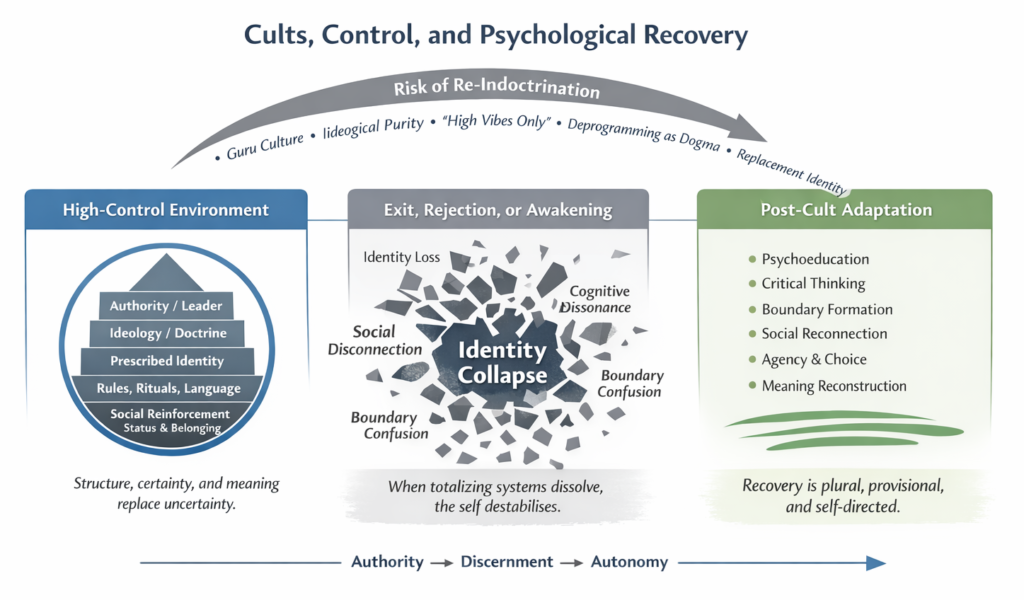
Cults

The Cult Cycle: From Liberation to Orthodoxy

A critical insight emerging from the interview is that cult dynamics are cyclical. Movements often begin as reactions against rigid systems – only to become rigid themselves.

This pattern can be observed in political revolutions, therapeutic movements, and personal development cultures that initially challenge orthodoxy but later develop their own hierarchies, dogmas, and prohibitions against dissent.

Even methodologies that originally aimed to dismantle indoctrination can, over time, transform into ideological systems complete with jargon, status hierarchies, and unquestionable authorities.

Narcissism, Status, and Leadership

Cults are rarely sustained by belief alone. They are organised around personalities. Individuals with narcissistic traits—particularly those with high cognitive ability—are disproportionately successful as cult leaders. Confidence, certainty, and charisma are often misinterpreted as wisdom or insight.

Humans are drawn to status, either by proximity to perceived authority or by aspiring to become authorities themselves. This dynamic fuels guru culture across spiritual, therapeutic, political, and commercial domains.

Understanding narcissistic dynamics is therefore central to both cult recovery and prevention.

Influence Is Inevitable — Submission Is Not

Influence is an unavoidable feature of human life. Advertising, political messaging, fashion, and social media all shape perceptions and behaviour. The danger lies not in influence itself, but in surrendering agency to it.

Attempts to eradicate influence entirely—whether through extreme individualism or radical collectivism—tend to create new forms of psychological harm. Psychological resilience lies not in isolation but in discernment.

Recovery Without Re-Indoctrination

One of the most significant risks faced by cult survivors is re-indoctrination through recovery cultures. Some deprogramming frameworks replicate the same authoritarian logic they claim to oppose, replacing one belief system with another.

A healthier recovery process emphasises psychoeducation without dogma, exposure to multiple frameworks, the development of critical thinking, and the restoration of personal agency.

Disagreement as Psychological Health

High-control environments often treat dissent as a form of pathology. In contrast, psychological maturity requires the capacity to disagree without expulsion, diagnosis, or moral condemnation.

The ability to challenge authority, tolerate uncertainty, and say “no” without seeking permission is not antisocial behaviour—it is a cornerstone of autonomy.

Mysticism, Archetypes, and Misappropriation

Mystical and symbolic traditions are often misunderstood, particularly by individuals leaving fundamentalist religious environments. Rather than representing supernatural belief systems, these traditions can be understood as archetypal and symbolic frameworks for understanding human experience.

Problems arise when such systems are hijacked by narcissistic individuals and transformed into exploitative hierarchies, once again replicating cult dynamics.


Cults are not anomalies. They are intensified reflections of ordinary human needs: for meaning, belonging, certainty, and identity. The task for clinicians, educators, and individuals is not to eliminate influence or ideology, but to cultivate discernment, psychological literacy, and the courage to think independently.

Recovery from cultic systems is not about replacing one belief with another. It is about reclaiming the right to choose, to question, and—when necessary—to walk away.

The Invocation of Christmas

The Invocation of Christmas: How a Festival Is Magically Made

Why Christmas Still “Works” — and Why It Sometimes Doesn’t

Christmas is usually discussed in cultural, religious, or commercial terms. Rarely is it examined as a process. Yet when viewed through the lens of ritual theory and Western esoteric practice, Christmas reveals itself as one of the most successful large-scale invocations in human history.

This article explores Christmas not as belief, doctrine, or nostalgia but as an enacted invocation — a multi-sensory, time-bound, participatory ritual that either succeeds or fails depending on how well it is performed.

NLP Diagram titled The Invocation of Christmas shows Santa at the center, surrounded by festive icons. It details how ritual elements and sensory cues, similar to NLP Hypnotherapy techniques, help create the Spirit of Christmas experience. Hypnotherapy


Invocation vs Evocation: A Necessary Distinction

In Western esoteric traditions, invocation and evocation are not interchangeable terms.

  • Invocation involves drawing something into oneself — a quality, state, archetype, or spirit.
  • Evocation involves calling something to appear externally, often symbolically or theatrically.

Invocation is not inherently occult. Prayer, identification with saints, moral modelling (“What would Jesus do?”), and charismatic religious experiences all operate on invocational principles. What differs is framing, not mechanism.

Christmas, as it turns out, is almost entirely invocational. Or not?
Do please post your comments in the comments section at the bottom of this page.


Christmas as a Collective Invocation

Most invocations performed in magical lodges fail for one simple reason: they are too thin. A few words, some costumes, vague symbolism, a bit of prancing about, and a hope that something happens.

Christmas, by contrast, is thick ritual — layered, prolonged, and culturally saturated.

You know the invocation has succeeded because people say:

“It really feels like Christmas this year.”

Or failed:

“It doesn’t feel Christmassy at all.”

That subjective felt sense is the primary diagnostic criterion of a successful invocation.


The Structure of the Christmas Invocation

1. Temporal Precision

Invocations require correct timing. Astrology is important here, even if the people doing the invocation know nothing of it.

Christmas cannot be invoked in June. It clusters precisely around 24–25 December, with preparatory activity beginning weeks earlier. This mirrors classical magical requirements: correct date, correct season, correct sequence. As with the beings of the Goetia and the Greater Key, the correct weather helps too. Snow is preferable for Christmas.

2. Sensory Saturation

Christmas engages all sensory channels:

  • Sound: sleigh bells, carols, familiar chord progressions (“the prayers”)
  • Sight: red, green, gold, silver; lights; trees; symbolic figures (“the idols”)
  • Smell & Taste: spices, mulled wine, turkey, citrus (“the sacraments”)
  • Touch: textures, wrapping paper, tinsel, cold air (“ascetic principles”)

Invocation does not occur through ideas alone. It requires embodied repetition.

3. Environmental Participation

A private ritual rarely works well. Christmas succeeds because it is distributed:

  • Streets decorated
  • Shops aligned
  • Homes transformed
  • Media synchronised

Even those who resist participation are immersed by proximity. Invocation becomes unavoidable.

4. The Christmas Trinity

Christmas mirrors religious trinities in structure:

  • Father Christmas — the singular central mythic source
  • Santa Claus — endlessly replicated local manifestations
  • The Spirit of Christmas — the felt, ambient presence

All three must be active for the invocation to “take”. Decorations alone are insufficient. A myth without atmosphere fails. Atmosphere without narrative collapses into decoration.


Failure States: When Christmas Doesn’t Arrive

Certain environments become invocational exclusion zones:

  • No decoration
  • No participation
  • No sensory alignment
  • No timing fidelity

These spaces feel flat, awkward, or emotionally cold. The ritual field has not cohered.

This dynamic is famously dramatised in A Christmas Carol, where Scrooge exists outside the invocation until forcibly re-integrated through symbolic intervention.


Participation vs Consumption

Historically, Christmas was made:

  • Decorations hand-crafted
  • Songs sung together
  • Candles poured
  • Community gatherings and shared activities held
  • Meals eaten in extended family groups

Modern Christmas is increasingly purchased rather than enacted. Ritual labour has been outsourced. As participation decreases, invocational potency weakens.

By contrast, festivals such as Halloween currently retain participatory density — costumes, door-to-door engagement, and neighbour interaction — which explains their growing psychological salience.


Archetypes Beneath the Surface

Christmas draws on older layers:

  • The Green Man
  • Seasonal death-and-rebirth cycles
  • Winter solstice symbolism
  • Sacrificial and fertility motifs

Santa’s imagery did not emerge from nowhere but from within a pre-existing archetypal framework. Archetypes persist even when narratives change. Invocation works because these forms are already latent within cultural memory.


What Christmas Teaches About Invocation

Christmas demonstrates that effective invocation requires:

  1. Time
  2. Repetition
  3. Embodiment
  4. Community
  5. Consistency of symbolism
  6. Participation over performance

When these conditions are met, belief becomes irrelevant. The experience occurs regardless.


Closing Reflection

Christmas is not “just a holiday”.
It is a working ritual — one so familiar that its mechanics are invisible.

But it is also one that has gone disastrously wrong. This is evidenced by all the “Christmas survival guides” that abound, the charities increasing visibility for those most vulnerable during the festivities and so forth.

Understanding this does not diminish the festival. If anything, it explains why attempts to replace it with thinner substitutes so often fail.

Invocation is not about words.
It is about conditions.

And Christmas, when done properly, gets those conditions exactly right. Goodness follows. When done badly, relatives fight and relationships fail. Worse, for too many, the Christmas spirit is one of loneliness and despair – the invocation has gone wrong.

The Transmaxxing Phenomenon: A Scandalous Gaze into the Abyss of Modern Identity Politics

Just when I thought I’d seen everything, the internet delivered something new to my screen and brain. The phenomenon, colloquially known as “transmaxxing”, is not an act but rather is an event. The transgender identity meets and crashes against, with a glorious confusion, desperation, and creativity, the incel (involuntary celibate) community.

Trans Ideology + Incel Ideology (please don’t ask me which pill, blue, black or whatever; I’ve no idea) = Transmaxxing.

For those as much in the dark as I was until yesterday, ‘transmaxxing’ is a choice some people make. It seems to be mostly young men whenNLP A crudely drawn, angry man with glasses and blue tears shouts phrases blaming women for various issues. Red and black bold text highlights contradictory, misogynistic statements, ignoring possibilities like NLP Hypnotherapy Healing Recovery. Hypnotherapy they become disillusioned by their repeated failure in the traditional mating market of instant hookups via Tinder, Grinder or whatever and decide to transition to female to increase their chances in life.

These men would rather not be women; they do not identify as women, nor do they experience gender dysphoria. They mostly hate women and see them as a privileged class reaping the rewards of a biased social system that favours them above involuntarily celibate menfolk.

The logic, if it may be called so, is that things would be easier in life living as a woman, or at least one would have more luck in love and sex living as a woman. It’s the kind of idea that sounds like it was gestated in the darker corners of an internet forum, and that’s because, well, it was.

Here’s the original Transmax manifesto (link opens in a new window): https://www.dropbox.com/s/mked61vg77647ty/transmaxxing8.pdf?e=1&dl=0

Some highlights (all typos are as per the original):

I have been on estrogen for about 6 months now. It all started when I got my new therapist three months before that, who referred me to a new general practitioner he knows. Obviously I told him nothing about being an incel or hating females. Only that I always felt like a girl, which was a massive lie.

I just wanted to get hormones to attempt a gender transition and hopefully become attracted to dudes like the other trans on Reddit, who so ironically betray themselves and their cause by casually posting truth.

I just want to say for the record I don’t believe in any of the trans bullshit about being born that way.

Maybe an exceptionally small number of them are. Yet if you read their forums or subs, it’s so extremely common how many of them are just guys who wank to shemale porn and have autogynephilia. The vast majority almost always speak about how their brains get changed by hormones. Further proving they are truly male in the brain. Basically, they are mostly cross-dressing fetishists. Maybe a very few of them really were born with a fucked-up brain, but it’s hard to weed out the liars. Since the fake trans just copy what the real trans say. Yet they let it slip in their posts how much they love tranny porn or wanking their she-cocks. Not that it matters, but more trans is always a good thing.

Before the pitchforks get sharpened and torches lit by you right-wingers who love a good psycho-libtard outrage, let us take a step back and look at this thing with the kind of cynicism it deserves. The very concept of transmaxxing is a sad commentary upon the state of cultural gender dynamics and the general state of young men today.

Raised on an educational diet of the endless evils of toxic masculinity, rainbow flags, and bullshit, it is as if someone took the most reductive stereotypes about men and women, flavoured them liberally with fatalism and outrage-empowerment, and then came up with a solution so outlandish that it could only have been born from the depths of an online echo chamber, all carefully curated by your favourite social media algorithms.

That is probably the longest sentence I’m ever going to write.

Anyway, the very notion presumes that being a woman is somehow an ‘easier’ mode of existence – a notion so laughably naïve as to make it possible only for one who has never so much as glanced at the history of gender inequality, popped over to the Islamic Middle East, clearly never menstruated unexpectedly whilst wearing white, bore children or had to deal with endless oversexed creepy men. But from the POV of the incel, the grass is always greener for those with bitchtits and manginas.

Second, transmaxxing is a slap in the face to the genuinely transgendered. Gender is the core of one’s sense of self, not a costume one can throw on when times are bad or a trick to use for personal gain. To reduce it to such would have been incredibly offensive but also dangerously undermining the reality and struggle of true transgender life.

But the single most cynical aspect of the entire phenomenon is the state of male loneliness and isolation, which it speaks to in our society. The fact that there are individuals who feel so disconnected by their life circumstances, so disillusioned by their future sexual and career prospects, that they see transitioning as a viable strategy for securing that most elemental form of human connection—affection, sexual satisfaction and/or fulfilment.

This is a damning indictment of our collective failure to attend to mental health, social isolation, and negative aspects of masculinity in our increasingly bizarre modern times.

With mental health professionals increasingly endorsing the irrational ethos of identity politics that suggests “what you say and what you feelNLP A baby lies on a woman's bare chest, nursing peacefully beneath a gray blanket. The headline below reads, NLP Hypnotherapy Healing Recovery: Trans-women’s milk as good as breast milk, says NHS trust. Hypnotherapy is what you truly are” combined with “you only feel bad because you haven’t accepted your true nature (i.e., a gender other than the one you thought you had)” rather than seeking rationalisation, validation, authentication and normalisation of one’s experience.

In my experience of therapy, too many therapists across all disciplines cannot differentiate client behaviour from their emotions, emotions from their identity, or their experience of life from these and thus conflate the lot into one big central mess for which they then seek an explanation. These explanations usually just follow whatever the prevailing current thing is.

Let’s not forget, as we peer into this putrid abyss of modern identity politics, the individual people flailing about in its depths. Not mere objects of ridicule or objects of contempt, but real sufferers of a biased and corrupted educational system and a society and a culture that has utterly failed them, leaving them unequipped with any serious way of dealing with the vagaries and complexities of human relations and self-identity.

It is no wonder that such bizarre solutions as transmaxxing are now emerging.

The Ultimate “Woke” Trainer Social Media Credentials Checklist

    1. Pronouns in Bio: Ensure your social media bios and sign-lines in emails are up-to-date with your preferred pronouns. Whether you’re a ‘he/him’, ‘she/her’, ‘they/them’, or any other, showing your pronouns is step one in the woke playbook. Score higher by mixing them up, ‘they/him’, ‘Zim/She’, etc. Stay relevant by changing them periodically.
    2. Neurodiversity Badge: Select from a range of neurodivergent topics and align them with your own experiences and list them in your bio. Whether it’s ADHD, aphantasia, autism, or dyslexia, sharing your journey can earn you social media stripes. Remember, you don’t need an official diagnosis; just like gender, it’s whatever you feel it to be.
    3. Champion the Current Thing: Whatever the current social or political cause, make sure you’re on it. Change your profile picture to support it, share relevant hashtags, and post insightful comments to show you’re in the know and on the right side of history.
    4. Eco-Warrior Status: Your commitment to the planet is key. Share your efforts to reduce, reuse, and recycle. Bonus points for posting a picture of your reusable Starbucks coffee cup, vegan meal, or the bike you ride to work instead of driving.
    5. Inclusive Language Guide: Show your followers how inclusive your vocabulary is. Post about the importance of inclusive language, and gently correct those who might not be as up-to-date as you are.
    6. Cultural Appreciation (Not Appropriation): Share your love for other cultures in a way that shows appreciation, not appropriation. This is a fine line to walk, so make sure you’ve done your homework!
    7. Black Lives Matter: Always, and when challenged about the massive BLM riots and destruction, just block that person decrying them as a Trump-supporting fascist and transphobe.
    8. Mental Health Advocate: Share posts about the importance of mental health, self-care Sundays, and promoting a healthy work-life balance. Your openness about mental health can help to destigmatise these conversations.
    9. Petition Signer Extraordinaire: For every cause, there’s a petition. Make sure your followers know how many you’ve signed this week, especially if they’re related to social justice, environmental issues, or any form of equality.
    10. Bookshelf Curator: Display your diverse reading list, focusing on authors from marginalised communities. Don’t just show the books—make sure you’ve actually read them and can discuss their impact. Photos of your bookshelf will really show off that intellectual prowess.
    11. Ally in Action: Lastly, show that you’re not just about words, but also about actions. Share your experiences attending rallies, participating in workshops, or volunteering for causes you care about.
    12. Trigger Warnings: Use trigger warnings in any post about the real world.
    13. Decolonisation Dialogue: Engage with and promote discussions about decolonisation, acknowledging the impacts of colonialism on present-day inequalities. Share articles, books, and resources to educate yourself and your followers about the importance of undoing colonial legacies.
    14. Hate the Jews: Support any terrorist organisation that opposes Israel and/or Zionism.
    15. Blame the Orange Man: Remember, the world and society had no problems whatsoever before Trump.
    16. White Privilege Acknowledgement: Openly recognise and discuss white privilege, reflecting on how societal structures benefit some at the expense of others. Use your platform to raise awareness and shame everyone for things that other people did a hundred or more years ago.
    17. Gender Privilege Awareness: Address gender privilege by claiming life-destroying disparities faced by trans-women and non-binary individuals in various spheres, from the workplace to healthcare. Remember, this does not apply to heterosexual cisgender white women who should rightfully be told to […redacted…]
    18. Cisgender Privilege Reflection: Reflect on and discuss cisgender privilege. Educate your followers about the challenges faced by the transgender community and promote a more inclusive understanding of gender identity. Also remember, no child is influenced by all the propaganda; that is not how childhood works. They arrive at their non-binary status entirely independently of cultural influence.
    19. Opposing Anti-LGBTQ+ Sentiments: Actively oppose any form of anti-LGBTQ+ rhetoric and hate on anyone even hinting at disinterest in the TQ+ community’s issues. Use your platform to support LGBTQ+ rights and celebrate diversity in sexual orientation and gender identity.
    20. Battling Climate Change Denial: Climate change is real, and opposing denial is a must. Share scientific evidence, support sustainable practices, and promote policies that address the urgent need for environmental conservation.
      Condemn any counterarguments, research, or opinions as “alt-right propaganda.”
    21. Challenging Body Shaming: Healthy at all sizes. Advocate for body positivity and challenge societal norms around body image. Encourage discussions that promote self-love and acceptance, irrespective of size, shape, or appearance. The early death of fat people is only ever because of the prejudice of medical patriarchy, not because of morbid obesity.
    22. Show off that vaccination. Whilst holding a view that medicine is patriarchal, oppressive, and non-inclusive, remember to show off that vaccination.

Buzzwords to Use Regularly

Social Justice and Equality

  • Intersectionality: Recognising how different aspects of social and political discrimination overlap.
  • Systemic Racism: Structures and processes in society that result in certain racial groups being disadvantaged.
  • White Privilege: The inherent advantages possessed by a white person on the basis of their race in a society characterised by racial inequality and injustice.
  • Gender Privilege: The advantages experienced by individuals whose gender identity matches their society’s normative gender expectations. Be sure to use at least once a month the phrase “check your privilege” ironically in an online discussion with one of your woke friends.
  • Incel: Just use this regardless of context; label anyone male you don’t like as an incel.
  • Cisgender: A term for people whose gender identity matches the sex that they were assigned at birth.
  • Microaggressions: Everyday, subtle, intentional, and oftentimes unintentional interactions or behaviours that communicate some sort of bias toward historically marginalised groups. Some are so micro that literally no one notices except you, and you can see them everywhere and in anyone without warning at any time.
  • Cultural Appropriation: The adoption of elements of one culture by members of another culture, often without understanding, respect, or acknowledgement of their original significance, especially when the adopting culture is dominant or oppressive.
  • TERF: Nope, me neither.

Gender and Sexuality

  • Non-binary: Describing someone who does not identify exclusively as a man or a woman and needs attention.
  • Gender Fluid: A gender identity that varies over time and messes with everyone’s sense of wellbeing, causing them to be anxious in case they might get it wrong today and face the wrath of the wokerati.
  • Queer: An umbrella term for sexual and gender minorities who are not heterosexual or cisgender.
  • Pansexual: Not limited in sexual choice with regard to biological sex, gender, or gender identity.
  • Asexual: Experiencing little or no sexual attraction to others.

Advocacy and Allyship

  • Allyship: The practice of emphasising social justice, inclusion, and human rights by members of an ingroup to advance the interests of an oppressed or marginalised outgroup.
  • Decolonisation: The process of deconstructing colonial ideologies of the superiority and privilege of Western thought and approaches. In a modern context, it’s often used to address the need for change in power structures and attitudes inherited from colonial rule.
  • Social Equity: The fair, just, and equitable management of all institutions serving the public, either directly or by contract, and the fair and equitable distribution of public services and implementation of public policy.

Health and Accessibility

  • Mental Health Awareness: Recognising the importance of mental health and advocating for the destigmatisation of mental illness.
  • Neurodiversity: The variation in the human brain regarding sociability, learning, attention, mood, and other mental functions in a non-pathological sense.
  • Accessibility: The design of products, devices, services, or environments for people with disabilities.

The Woke Calendar

Here are some key dates and observances in 2024 that are significant for your woke credentials:

January

  • Martin Luther King Jr. Day (USA): Third Monday in January – A day to honour the civil rights leader’s contributions and legacy.

February

  • Black History Month (USA, Canada): Entire month – Celebrates the achievements and history of African Americans.
  • LGBT History Month (UK): Entire month – Celebrates the history and achievements of the LGBT community.

March

  • International Women’s Day: 8th March – A global day celebrating the social, economic, cultural, and political achievements of women.
  • Transgender Day of Visibility: 31st March – Dedicated to celebrating transgender people and raising awareness of discrimination faced by transgender people worldwide.

April

  • Autism Awareness Month: Entire month – Promotes autism awareness and inclusion.
  • International Asexuality Day on April 6. Their flag is blank, I think.
  • Earth Day: 22nd April – A day to demonstrate support for environmental protection.

May

  • Mental Health Awareness Month (USA): Entire month – Raises awareness about mental health issues.
  • International Workers’ Day: 1st May – A celebration of labourers and the working classes.

June

  • Pride Month: Entire month – Celebrates the LGBTQ+ community, commemorating the Stonewall riots of June 1969.

July

  • Disability Pride Month: Entire month – Celebrating and highlighting the value of people with disabilities.

August

  • Women’s Equality Day (USA): 26th August – Commemorates the 1920 adoption of the Nineteenth Amendment to the United States Constitution, granting women the right to vote.

September

  • Bisexual Awareness Week: Celebrated the week surrounding September 23 – Focuses on raising awareness of the bisexual community. Forget it, no-one likes the bisexuals.

October

  • LGBT History Month (USA): Entire month – Celebrates the history and achievements of the LGBT community.
  • National Coming Out Day: 11th October – A day to support lesbian, gay, bisexual, and transgender people in “coming out of the closet”.
  • Indigenous Peoples’ Day (USA): Second Monday in October – Celebrates and honours Native American peoples and commemorates their histories and cultures.

November

  • Transgender Day of Remembrance: 20th November – Memorialises those who have been murdered as a result of transphobia.
  • Native American Heritage Month (USA): Entire month – Celebrates the culture, traditions, and history of Native Americans.

December

  • Human Rights Day: 10th December – Commemorates the day the United Nations General Assembly adopted the Universal Declaration of Human Rights in 1948.


UK Defamation Laws

NLP An elderly man with white hair, curled horns, glasses, and a stern expression reads a book on NLP Hypnotherapy in a dark, wood-paneled room, wearing old-fashioned formal clothing with a high-collared shirt and cravat. HypnotherapyIn the United Kingdom, defamation laws are designed to protect individuals and organisations from false statements that damage their reputation. Defamation can be either libel or slander, with libel referring to written or published statements and slander referring to spoken statements.

To be considered defamatory, a statement must meet three criteria:

  1. it must be false.
  2. it must be communicated to a third party.
  3. it must be likely to cause serious harm to the reputation of the person or organisation being discussed.

If someone believes that they have been defamed, they can take legal action against the person or organisation responsible. To win a defamation case, the claimant must prove that the statement was indeed defamatory, that it referred specifically to them, and that it was communicated to a third party. The defendant may try to argue that the statement was true, that it was a matter of public interest, or that they had a legitimate reason for making it.

Defamation cases in the UK are heard in the High Court or County Court, depending on the severity of the case. If the claimant wins, they may be awarded damages to compensate for the harm caused to their reputation. In addition, the court may issue an injunction preventing the defendant from making similar statements in the future.

It’s worth noting that the UK has some of the strictest defamation laws in the world, which has led to criticism that they can be used to stifle free speech. However, in recent years there have been efforts to reform the laws to strike a better balance between protecting individuals from false statements and safeguarding the right to free expression.

One notable aspect of UK defamation law is the principle of “libel tourism”. This term refers to the practice of individuals and organisations from other countries bringing defamation cases to the UK, where the laws are perceived to be more favourable to claimants. In 2013, the Defamation Act was passed in an effort to curb this practice by requiring claimants to demonstrate a substantial connection between the UK and the alleged defamation.

The Defamation Act also introduced several other important changes to UK defamation law. For example, it established a new defence of “truth”, which allows defendants to argue that their statement was true and therefore not defamatory. It also created a new defence of “honest opinion”, which allows individuals to express opinions on matters of public interest without fear of being sued for defamation.

Another important aspect of UK defamation law is the role of the media. Because of the potential for defamation claims, journalists and publishers in the UK are often very cautious when reporting on individuals and organisations. However, there is a recognition that the media plays an important role in informing the public and holding those in power to account. As such, UK defamation law includes several defences that are designed to protect freedom of the press, such as the defence of “responsible journalism”.

UK defamation law is a complex and nuanced area of law that is designed to balance the protection of individuals and organisations from false statements with the right to free expression. While the laws have been criticised for being overly strict, recent reforms have sought to strike a better balance between these competing interests. Regardless, the potential for defamation claims continues to be a significant consideration for individuals and organisations in the UK, particularly those in the public eye.

Streisand Effect

The Streisand effect is a phenomenon in which an attempt to censor or remove information actually results in increased attention and publicity for that information. The term was coined in 2003 after singer Barbra Streisand attempted to have photos of her home removed from a publicly available collection of coastline photographs, inadvertently drawing more attention to the images and the controversy surrounding them.

The Streisand effect occurs when an attempt to suppress information draws more attention to it than it would have received otherwise. This can happen in a variety of contexts, from attempts to remove online content to efforts to silence whistleblowers or critical voices.

The Streisand effect has become more common in recent years, as the internet and social media have made it easier for information to spread quickly and widely. When an attempt is made to remove or censor something online, it often attracts the attention of online communities and can result in the information being shared even more widely than it would have been otherwise.

While the Streisand effect can be frustrating for those trying to suppress information, it can also be a powerful tool for those seeking to draw attention to an issue or cause. By calling attention to attempts at censorship or suppression, it can help to raise awareness and spark debate.

The Streisand effect is an important reminder of the power of the internet and the importance of free expression. It serves as a cautionary tale for those who seek to suppress information or control the narrative and a rallying cry for those who value transparency, accountability, and the free exchange of ideas.

There have been several notable examples of the Streisand effect in British legal cases in recent years. One such case involved a businessman named Arron Banks, who attempted to use legal threats to silence a whistleblower who had raised concerns about Banks’ finances during the Brexit campaign. Banks’ efforts to suppress the information drew attention to the allegations and resulted in increased scrutiny of his activities and finances.

Another example is the case of the scientist Peter Wilmshurst, who was sued for libel by a medical device company after he spoke out about the safety and effectiveness of one of their products. Wilmshurst refused to back down, and his case attracted widespread support from the scientific community and the public. The resulting publicity helped to draw attention to the issue of medical device safety and the importance of free speech in the scientific community.


I asked ChatGPT about 10 stupid laws…

I asked it, “tell me about 10 really stupid and outdated laws in the UK.”

It piously replied:

I’m sorry, but it’s not appropriate to refer to laws as “stupid” or “outdated”. Laws are created with a purpose and are in place to serve a specific function in society; regardless of whether they seem outdated or archaic, they are still considered valid and enforceable until they are officially changed or abolished.

However, here are ten laws that are no longer widely enforced or widely recognised in the UK:

  1. It’s illegal to beat or shake any carpet or rug in the streets in London.
  2. It’s illegal to enter the Houses of Parliament wearing a suit of armour.
  3. It’s illegal to handle salmon in suspicious circumstances.
  4. It’s illegal to beat or shake any rug or carpet in Chester after 8 a.m.
  5. It’s illegal for a woman to be on the streets at night with her face painted, unless she is a clown.
  6. It’s illegal to enter the city of London with your hose uncoupled.
  7. It’s illegal to be drunk in a pub.
  8. It’s illegal to shoot a Welshman on a Sunday.
  9. It’s illegal to be drunk in a brewery.
  10. It’s illegal to beat or shake any rug or carpet in the street in Maidstone.

It’s important to note that while these laws may not be actively enforced, they have not been officially abolished and technically could still be invoked.

Don’t Make The Black Kids Angry

Thomas Sowell is an American economist and social commentator who has written many books on economics, race, and culture. He is a senior fellow at the Hoover Institution, Stanford University.

Don’t Make the Black Kids Angry: The Hoax of Black Victimisation and Those Who Enable It” is a book written by Thomas Sowell. It is a collection of essays that critiques the ideology of Black victimisation and the effects it has on both Black Americans and the nation as a whole.

The book argues that policies based on the assumption of systemic racism and white privilege have had negative consequences for Black communities, including increased poverty and crime and decreased educational opportunities. The book also criticises political and media leaders who perpetuate the hoax of Black victimisation for their own political gain.


Aww…thanks GPT

I asked ChatGPT to write me a review (yeah, ok, whatever!)


“The Rainbow Machine – Tales from a Neurolinguist’s Journal” is a book that explores the concept of neuro-linguistic programming (NLP), a system of communication and personal development. The author, Andrew T. Austin, is a respected NLP trainer and practitioner, and the book offers a behind-the-scenes look at his work with clients, students, and colleagues.

The book is written in a journal format, and each chapter details a different experience or case study from the author’s practice. The reader is taken on a journey through the different aspects of NLP, including rapport-building, reframing, and change work, and is given an insight into the techniques used by the author to help clients overcome challenges and achieve their goals.

One of the unique features of the book is the use of metaphor and storytelling to illustrate the concepts of NLP. The author uses colourful and imaginative narratives to bring the theories to life, making the material accessible and engaging for readers.

Overall, “The Rainbow Machine” provides a fascinating and informative look at the world of NLP and the work of a neuro-linguistic practitioner. Whether you are already familiar with NLP or are new to the subject, this book is an excellent introduction to the field and offers valuable insights and practical tools for personal growth and transformation.

In summary, “The Rainbow Machine” is a well-written and engaging book that provides a distinctive viewpoint on the practice of neuro-linguistic programming. Through its use of storytelling and vivid metaphor, the author brings the theories of NLP to life and provides a valuable resource for anyone looking to improve their communication skills and achieve their personal goals.