Dismissive Presuppositional Reframing: Flippant Reframing Followed by Presuppositional Reinforcement
This is a manipulation pattern in which a person responds to a genuine problem by replacing the stated reality with a trivialising explanation of their own, then prevents that explanation from being examined by asking a reinforcing question that assumes it is already true.
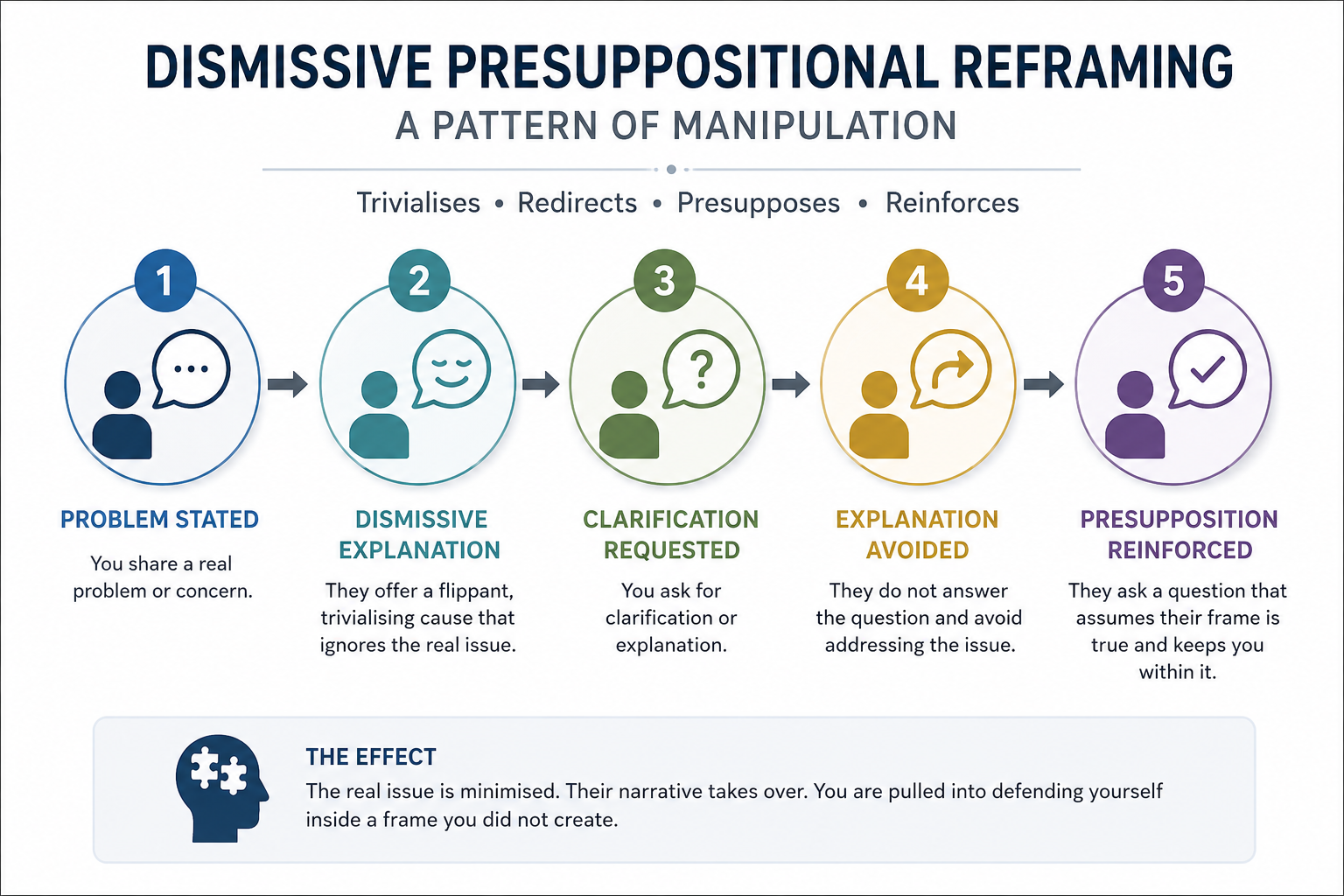
Basic Structure
- You state a problem. “I have chronic digestion issues.”
- They substitute a dismissive cause. “It’s all those curries you eat.”
- You ask for clarification. “What do you mean by that?”
- They do not explain. Instead of answering, they preserve the original insinuation.
- They ask a reinforcing question. Example: “Well, you like curry, don’t you?”
What Is Happening Psychologically?
The person has shifted from your actual issue to a preferred narrative in which the problem is somehow caused by your habits, choices, appetite, culture, personality, or supposed lack of discipline.
The important move is that they do not defend the claim directly. They make a casual insinuation, then when challenged, they ask a question that makes the insinuation harder to reject without seeming evasive.
The Manipulation Formula
Problem stated → trivialising explanation imposed → clarification requested → explanation avoided → presupposition reinforced through a question.
Or more simply:
They do not answer the question you asked. They ask a new question that forces you to stand inside their framing.
The Key Mechanisms
1. Trivialisation
Your problem is reduced from something serious or medical into something casual, silly, self-inflicted, or deserving of mockery.
“Chronic digestion issues” becomes “you eat too many curries.”
Two more examples:
“I’m exhausted from a chronic health condition” becomes “you just stay up too late.” “I’m struggling with ongoing pain” becomes “you’re probably just not exercising enough.”
2. False Causation
They imply a cause without evidence. The issue is no longer understood in terms of the known medical condition, but through their invented explanation.
3. Presupposition
The follow-up question contains an assumption hidden inside it.
“Well, you like curry, don’t you?” does not ask whether curry is relevant. It assumes curry is relevant and asks you to confirm a smaller detail inside that frame.
4. Frame Control
Instead of discussing the actual condition, the conversation is redirected to whether you like curry. This moves the conversation away from the medical reality and into their preferred interpretation.
5. Burden Shifting
You now have to defend yourself against an insinuation they never properly argued for.
They made the accusation lightly, but you are expected to answer seriously.
6. Plausible Deniability
If challenged, they can retreat into:
- “I was only joking.”
- “I was just asking.”
- “You’re being too sensitive.”
- “I didn’t say it caused it.”
This allows them to inject the implication while denying responsibility for having done so.
If the other person is in the “one up” position (i.e. your senior, your parent, boss etc) then tone policing may be enacted, governing the tone and manner by which you now communicate, i.e. “No need to be like that, I was only asking”, or the more extreme end of the tone-policing spectrum, “do not speak to me like that”
The Conversational Trap
The trap is that answering the second question often confirms the frame.
If you say, “Yes, I like curry,” they can treat that as support for their implication.
If you say, “That’s not the issue,” they can portray you as defensive.
If you get annoyed, they can shift the topic again to your tone rather than their dismissal.
The Hidden Message
The underlying message is often something like:
“Your problem is not as real as you say it is. It is probably your own fault, and I am entitled to reinterpret it for you.”
Generic Template
| Stage | Move | Function |
|---|---|---|
| 1 | You state a real problem | Establishes the original reality |
| 2 | They offer a flippant explanation | Trivialises and redirects the issue |
| 3 | You ask for clarification | Invites accountability |
| 4 | They avoid explaining | Avoids responsibility for the implication |
| 5 | They ask a question that assumes their frame | Makes you answer from inside their premise |
How to Respond Cleanly
Whilst strangling the other person may be the desired response, an alternative response is not to answer the reinforcing question immediately. First, return to the original evasion.
Option 1: Name the Move
“That does not answer my question. I asked what you meant by saying it was caused by curry.”
Option 2: Reject the Presupposition
“Whether I like curry is not the point. You implied that my medical condition is caused by curry. Are you saying that seriously?”
Option 3: Demand the Claim Be Made Clearly
“Please say directly what you are claiming. Are you saying my chronic medical condition is caused by eating curry?”
Option 4: Close the Frame
“No, I am not discussing my diet as a substitute for the medical issue. The condition is already diagnosed.”
Option 5: Identify the Dismissal
“That sounds dismissive. I am talking about a chronic condition, not asking for a joke explanation.”
The Cleanest Boundary Statement
“You made an implication, and when I asked what you meant, you avoided answering and asked a question that preserved the implication. I am not accepting that frame. If you have a serious point, state it directly…”
Adding, “…or fuck off” after “state it directly…” is entirely optional.
Condensed Model
Dismissive Presuppositional Reframing occurs when a person responds to a stated problem by imposing a trivialising explanation, then reinforces that explanation through a question that assumes its own relevance, rather than answering a request for clarification.
Its function is to move the conversation away from the stated reality and into a frame where the other person controls the meaning, the cause, and the burden of explanation.
It’s beautifuly explained, now I’m interested in your model