Understanding Emotions as Precursors, Transitional Processes, and End-Point States
Abstract: This article proposes a directional model of emotion in which emotional states are understood not merely as isolated experiences but as parts of unfolding psychological sequences. Within this model, some emotions function primarily as precursors, signalling friction, obstruction, uncertainty, or unmet need. Others operate as transitional emotions, organising perception, behaviour, and interpersonal response. A further group may be understood as end-point emotional states: relatively consolidated psychological conditions that emerge after repeated, unresolved, or reinforced emotional processes – these are the ones that frequently result in clinical diagnoses. This framework offers a useful way of understanding how ordinary emotional reactions may develop into more persistent states such as resentment, helplessness, anxiety, burnout, or depression.
Contents
- Introduction
- From Flat Categories to Directional Processes
- The Three Levels of the Model
- Precursor Emotions
- Transitional Emotions
- End-Point Emotional States
- Limitations of the Model
- Summary of the Model
Introduction
Emotions are often described as discrete, self-contained events. A person is described as angry, anxious, ashamed, sad, resentful, or depressed, as though each emotional state exists independently of what came before it. While this kind of categorisation is useful for naming experience, it can obscure an important feature of emotional life: emotions often unfold in sequences. Hopefully, IEMT trainees will already be familiar with the concept.
A person may begin with frustration, move into anger, and then settle into resentment. Another may begin with uncertainty, move into anxiety, then develop avoidance and eventually a more generalised sense of helplessness. A third may experience repeated disappointment, which becomes discouragement, then resignation, and finally depression.
This suggests that emotions can be understood not only by their content, but also by their position within a process. Some emotions appear early in a sequence. Others shape the direction of the response or represent the accumulated outcome of repeated or unresolved emotional processes.
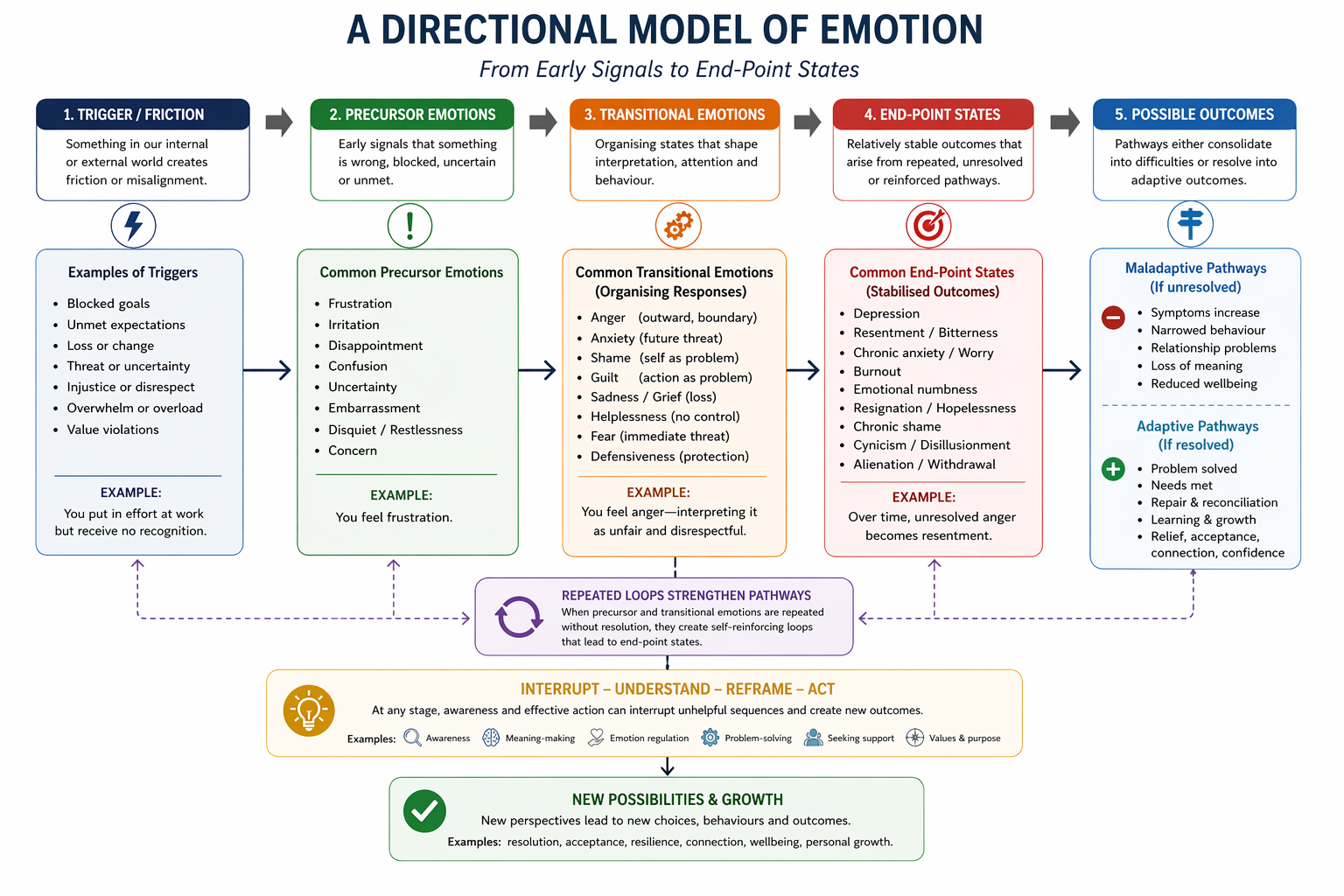
The model proposed here organises emotions into three broad functional categories:
- Precursor emotions: early signals that indicate friction, obstruction, threat, unmet expectation, or uncertainty.
- Transitional emotions: organising states that direct attention, behaviour, interpretation, and interpersonal response.
- End-point states: more consolidated emotional or psychological conditions that arise from repeated, unresolved, or reinforced emotional pathways.
Please note that this classification is not a rigid taxonomy. The same emotion may function differently depending on context; there is much nuance here, something that therapists often struggle with in their understanding.
Anger, for example, may be transitional in one sequence and an endpoint in another. Sadness may be a natural response to loss, a transitional stage in grieving, or part of a depressive end-state. The value of the model lies not in fixing emotions into permanent categories but in asking, ‘Where is this emotion in the sequence?’
From Flat Categories to Directional Processes
Many common approaches to emotion classify feelings according to type: anger, fear, sadness, joy, disgust, shame, guilt, surprise, and so on. These classifications can be useful, especially for emotional literacy. However, they often present emotions as a flat list.
A directional model asks different questions:
- What came before this emotion?
- What does this emotion tend to lead to?
- What behaviours does it organise?
- What belief or interpretation does it reinforce?
- What happens if the sequence repeats over time?
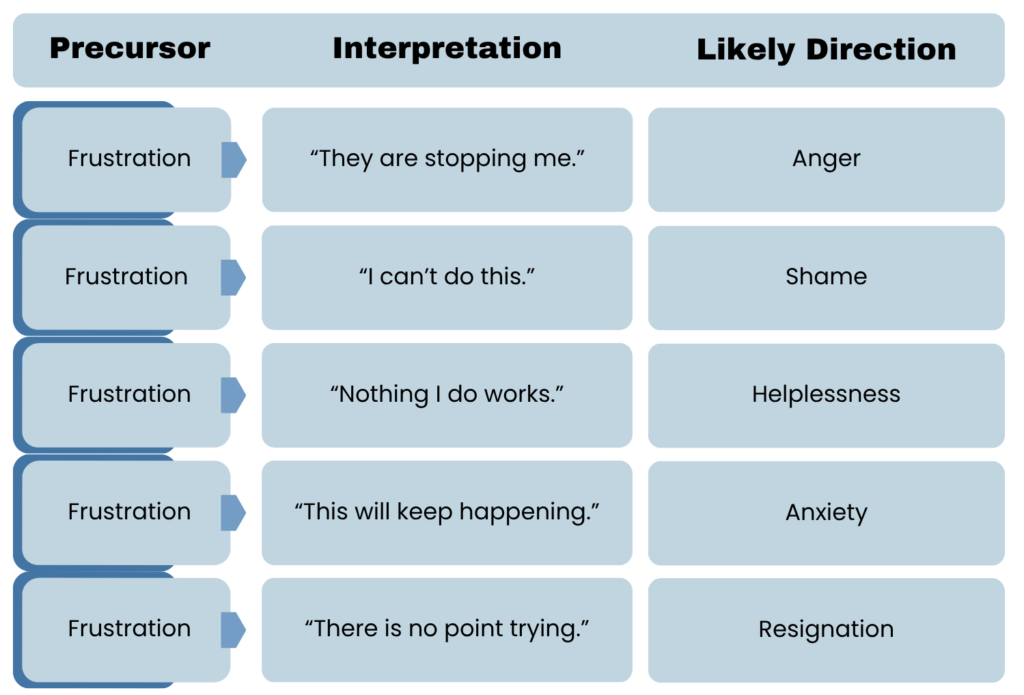
For example, consider the emotion/state of frustration. Frustration is rarely the final state; it usually points to something else, e.g., a blocked goal, repeated obstruction, an unmet expectation, loss of control, or a failed attempt to complete an action. From there, frustration may move in several directions.
- Frustration may escalate into anger if the person interprets the obstruction as unfair or as caused by another person.
- Frustration may lead to helplessness if a person concludes that nothing they do will make a difference.
- Frustration may lead to shame if the person interprets the difficulty as evidence of personal inadequacy.
- Frustration may become anxiety if the person anticipates future failure or negative consequences.
- Frustration may give way to resignation if repeated effort produces no meaningful change.
The same starting emotion can therefore lead to multiple outcomes depending on interpretation, context, personal history, social response, and available action.
Simple directional sequence:
Friction → Precursor Emotion → Transitional Emotion → End-Point State
Example: blocked goal → frustration → anger → resentment
Example: blocked goal → frustration → helplessness → depression
The Three Levels of the Model
The model can be summarised as a movement from an early signal to an organised response and then to a consolidated state.
1. Precursor Emotions
Precursor emotions are often brief, reactive, and situational. They signal that something requires attention. They do not necessarily tell the person what to do; rather, they indicate that a psychological or social adjustment may be needed.
Examples include:
- Frustration
- Irritation
- Confusion
- Uncertainty
- Disappointment
- Embarrassment
- Awkwardness
- Disquiet
- Concern
- Restlessness
Note: Many of these are social emotions.
2. Transitional Emotions
Transitional emotions begin to organise the person’s perceptions and responses. They shape attention, prepare action, and often recruit a narrative. At this level, the person is no longer simply noticing that something is wrong; they are beginning to interpret what it means and what should happen next.
Examples include:
Note: Many of these are responsive emotions.
3. End-Point Emotional States
End-point states are relatively stable outcomes of emotional processing. They may arise when emotional sequences are repeated, unresolved, socially reinforced, or tied to identity. They often become self-maintaining because they influence how the person interprets later events.
Examples include:
- Depression
- Resentment
- Bitterness
- Burnout
- Chronic anxiety
- Emotional numbness
- Resignation
- Cynicism
- Chronic shame
- Alienation
Note: Not all end-points are maladaptive. Relief, acceptance, resolution, forgiveness, confidence, and calm may also be end-point states when emotional processes are successfully completed.
Precursor Emotions
Precursor emotions are early indicators that something in the person’s internal or external world is not yet resolved. They are often subtle and may be overlooked because they do not always appear clinically dramatic. When raised in clinical settings, they may be dismissed by the therapist via normalisation and reframing. However, they are highly significant because they often determine the direction of the subsequent emotional sequence.
Frustration as a Hub Precursor
Frustration is one of the clearest examples of a precursor emotion. It typically arises when an intended action, goal, desire, or expectation is blocked. It contains a sense of effort that meets obstruction.
Examples:
- A person tries repeatedly to explain themselves but feels misunderstood.
- An employee works diligently but receives no recognition or promotion.
- A parent tries to maintain calm but is repeatedly interrupted or challenged.
- A student studies diligently but continues to receive poor marks.
- A person attempts to rest but is constantly disturbed by responsibilities.
Frustration may lead to very different emotional outcomes depending on how the situation is interpreted.
Disappointment as a Precursor
Disappointment arises when expectation and outcome fail to align. It is often quieter than frustration but may be just as consequential.
Examples:
- A friend forgets an important event.
- A long-awaited opportunity falls through.
- A person receives less support than expected.
- A relationship fails to develop as hoped.
Disappointment may develop into sadness, resentment, cynicism, or acceptance depending on the meaning attached to it.
Example sequence:
Expectation → disappointment → sadness → withdrawal → loneliness
Expectation → disappointment → anger → resentment → bitterness
Expectation → disappointment → reflection → adjustment → acceptance
Uncertainty as a Precursor
Uncertainty is a common precursor to anxiety. In itself, uncertainty is not necessarily distressing. It becomes problematic when the person interprets uncertainty as danger, incompetence, exposure, or impending loss.
Examples:
- Waiting for medical test results.
- Not knowing whether one’s job is secure.
- Entering a social situation with unclear rules.
- Beginning a new relationship without knowing the other person’s intentions.
Uncertainty can lead to curiosity, preparation, anxiety, avoidance, or control-seeking. The direction depends on the person’s tolerance for ambiguity and their perception of available resources.
Transitional Emotions
Transitional emotions are more organised than precursor emotions, and sometimes this organisation is part of the problem, it stabilises them into an identity. They tend to prepare action and shape interpretation, and they may also become self-reinforcing if repeated frequently, i.e., “It’s just who I am.”
Anger as a Transitional Emotion
Anger often arises when a person perceives obstruction, injustice, violation, disrespect, or threat to boundaries. It mobilises energy and directs attention outward.
In adaptive form, anger can support boundary-setting, protest, self-protection, and repair. In maladaptive form, it can become aggression, blame, contempt, or chronic resentment.
Examples:
- A worker becomes angry after repeated unpaid overtime.
- A partner becomes angry after feeling dismissed in conversation.
- A teenager becomes angry when treated as incapable or untrustworthy.
- A patient becomes angry after feeling ignored by professionals.
Anger may resolve if effective action becomes possible. It may consolidate into resentment if the perceived injustice remains unresolved.
Anger pathway:
Frustration → anger → protest → repair → relief
Frustration → anger → blocked protest → rumination → resentment
Anxiety as a Transitional Emotion
Anxiety organises attention around anticipated threats. It is future-oriented and often involves hyper-vigilance, prediction, preparation, avoidance, or reassurance-seeking.
Examples:
- A person becomes anxious before public speaking.
- A parent becomes anxious when a child is late getting home.
- An employee becomes anxious after receiving vague criticism.
- A person becomes anxious after noticing unexplained bodily symptoms.
Anxiety may lead to useful preparation. However, if it repeatedly produces avoidance, it can narrow the person’s life and contribute to chronic fearfulness.
Anxiety pathway:
Uncertainty → anxiety → preparation → successful coping → confidence
Uncertainty → anxiety → avoidance → short-term relief → long-term restriction
Shame as a Transitional Emotion
Shame is a socially organised emotion involving exposure, inadequacy, defectiveness, or loss of status. It turns attention toward the self as the perceived problem.
Examples:
- A person feels shame after making a mistake in public.
- A child feels shame after being mocked by peers.
- An adult feels shame when asking for help.
- A professional feels shame after receiving criticism.
Shame may lead to repair, humility, and social learning when mild and well-contained. When intense or repeated, it may lead to concealment, withdrawal, self-attack, perfectionism, or chronic low self-worth.
Guilt as a Transitional Emotion
Guilt differs from shame in that it usually concerns an action (behaviour) rather than the whole self (identity). Shame says, “I am bad.” Guilt says, “I did something wrong.”
Guilt can be highly adaptive when it supports responsibility, apology, restitution, and behavioural correction. It becomes problematic when exaggerated, misplaced, or impossible to resolve.
Examples:
- A person feels guilty after speaking harshly to a friend.
- A parent feels guilty for not spending enough time with a child.
- A worker feels guilty for taking a rest while colleagues are busy.
- A survivor feels guilty for having survived when others did not.
Resolved guilt may lead to repair. Unresolved guilt may contribute to self-punishment, chronic anxiety, or depressive states.
End-Point Emotional States
End-point states are the more consolidated outcomes of emotional sequences. They tend to persist beyond the original trigger and may become part of a person’s general orientation toward life, relationships, or selfhood.
Depression as an End-Point State
Depression can be understood, in many cases, as an end-point state arising from multiple unresolved precursor and transitional processes. This does not mean depression has a single cause, nor does it reduce it to mere sadness. Rather, it highlights that depressive states often represent the accumulated outcome of repeated emotional sequences involving loss, helplessness, disappointment, defeat, exhaustion, shame, isolation, or unresolved stress.
Possible pathways into depression include:
- Repeated frustration → helplessness → resignation → depression
- Repeated disappointment → sadness → withdrawal → depression
- Unresolved shame → concealment → isolation → depression
- Chronic anxiety → exhaustion → loss of agency → depression
- Grief → prolonged disconnection → meaning collapse → depression
- Overwork → depletion → burnout → depression
This model is useful because it discourages viewing depression as an isolated emotional category. Instead, it asks what processes have converged to produce the depressive state.
Resentment as an End-Point State
Resentment often emerges from unresolved anger. It is anger that has become narratively organised and temporally extended. The person may no longer be actively angry all the time, but the emotional system remains organised around perceived injustices.
Examples:
- An employee remains resentful after years of feeling undervalued.
- A sibling remains resentful after perceived parental favouritism.
- A partner becomes resentful when repeated emotional labour goes unnoticed.
- A community becomes resentful after persistent institutional neglect.
Resentment commonly contains three elements: remembered injury, blocked repair, and continued moral protest.
Burnout as an End-Point State
Burnout may be understood as an endpoint state of prolonged effort without sufficient recovery, recognition, control, or meaning. It often follows repeated cycles of stress, frustration, obligation, and depletion.
Examples:
- A teacher works under increasing administrative pressure with little support.
- A carer provides constant care without adequate rest.
- A therapist carries a high emotional load without proper supervision or recovery.
- A manager is responsible for outcomes but lacks the authority to change conditions.
Burnout frequently includes emotional exhaustion, cynicism, reduced efficacy, irritability, detachment, and loss of motivation.
Chronic Anxiety as an End-Point State
Anxiety may begin as a situational response to uncertainty or threat. Over time, however, anxiety can become a general orientation. The person begins not merely to feel anxious about specific events but to live in a state of anticipatory vigilance.
Examples:
- Social anxiety develops after repeated or significant embarrassment or rejection.
- Health anxiety develops after unexplained bodily symptoms.
- Generalised anxiety develops after prolonged instability.
- Performance anxiety develops after repeated or significant criticism or failure.
In such cases, anxiety is no longer simply a passing emotion. It becomes a perceptual style.
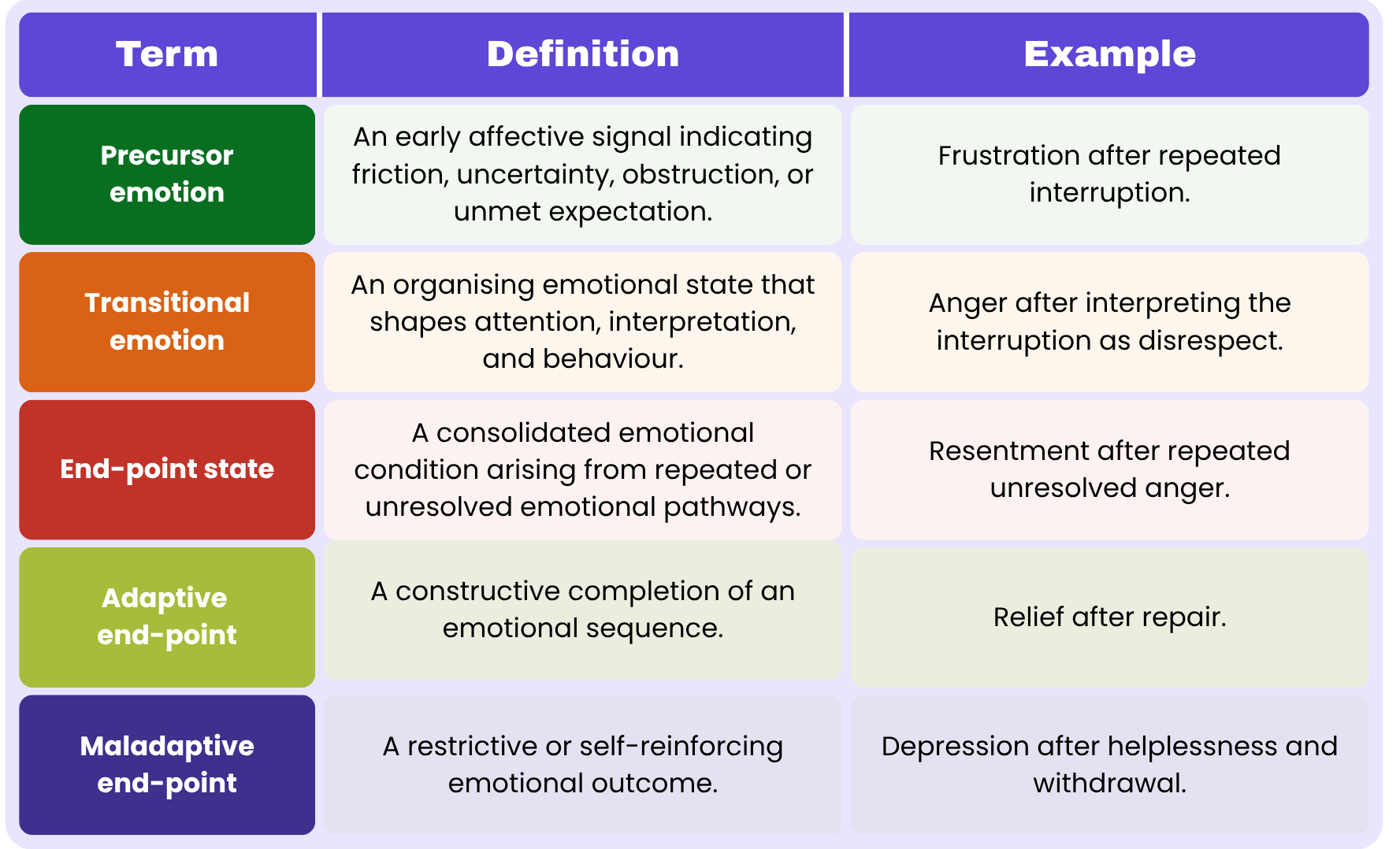
Proposed Terminology
The following terminology may be useful when further developing the model.
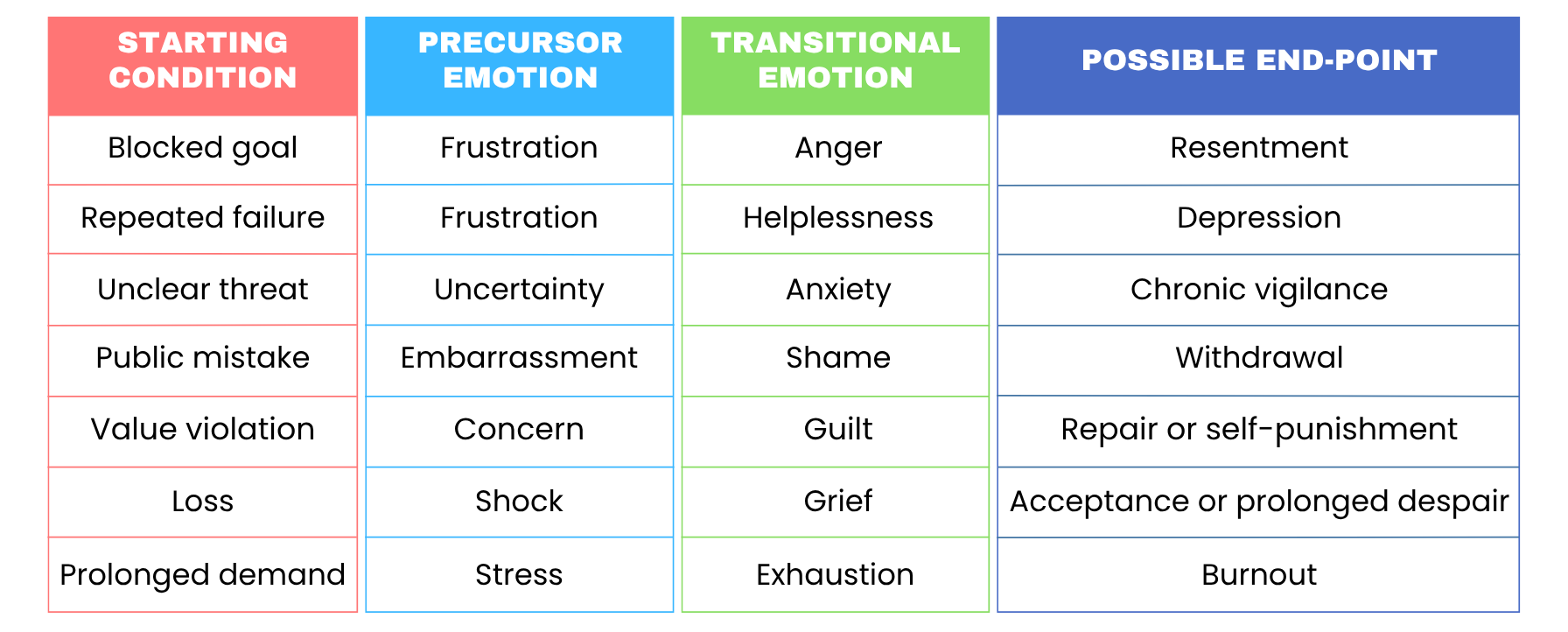
A Working Map of Common Emotional Pathways
Limitations of the Model
Any model of emotion risks oversimplification. Human emotional life is not linear in a strict mechanical sense. Emotions may loop, overlap, contradict one another, or appear simultaneously. A person may feel anger and guilt together, anxiety and excitement together, or grief and relief together.
Several cautions are therefore necessary.
1. The Same Emotion Can Occupy Different Positions
Anxiety may be transitional in one sequence and an endpoint in another. Shame may arise as a brief social signal or become a chronic organising state. Sadness may be a normal response to loss or part of depression.
2. Emotional Sequences Are Not Always Linear
A person may move from anger to shame, then back to anger. Another may move from anxiety to avoidance, then to guilt, and finally to renewed anxiety. The model should therefore be used as a map of tendencies, not a fixed law.
3. Biological, Social, and Environmental Factors Matter
Emotional end-states may be influenced by sleep, illness, medication, trauma, poverty, relational instability, workplace conditions, social exclusion, and many other factors. The model should not be used to imply that emotional suffering is merely a matter of internal sequencing.
4. End-Point States May Require Direct Attention
Although it is useful to trace end-point states back to precursor processes, this does not mean the end-point can be ignored. Depression, burnout, chronic anxiety, and severe shame may require direct care, support, treatment, and environmental change.
Summary of the Model
The directional model of emotion can be summarised as follows:
- Emotions are not only categories; they are also parts of processes.
- Some emotions function as early signals of friction, obstruction, uncertainty, or unmet need.
- Some emotions organise behaviour, attention, interpretation, and interpersonal responses.
- Some emotional states represent consolidated outcomes of repeated or unresolved processes.
- End-point states may be maladaptive, such as depression or resentment, or adaptive, such as relief, acceptance, or resolution.
- Understanding the pathway into an emotion may be as important as naming the emotion itself.