Certain communication patterns can make everyday interactions feel confusing, frustrating, or unproductive. Identifying these patterns helps explain why conversations go awry.
None of the following examples are autobiographical but are given as illustrations of everyday examples of these common and frustrating communication patterns.
I haven’t included gaslighting here, as it is well-covered elsewhere.
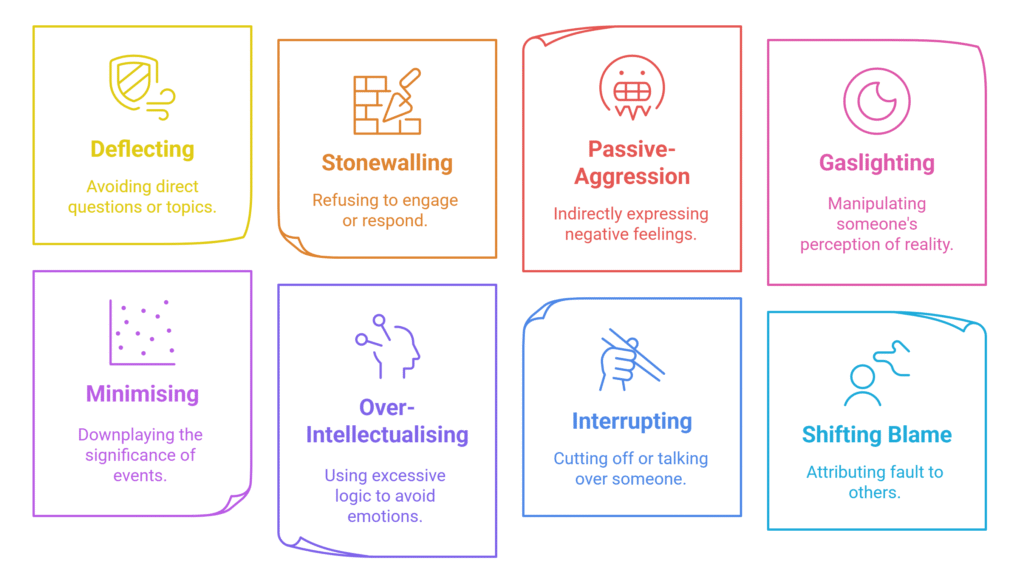
Tangential Communications
A pattern where an individual responds to a direct query with unrelated statements or questions, thereby consistently sidestepping the original topic and avoiding a direct answer.
CONTEXT #1: We have both been to the store to buy a specific product, “Nimmy Bob 2000,”, which is needed for some repairs in the house. Upon my return, I spend hours using the “Nimmy Bob 2000″ in full sight of the other party, who comments upon the repairs. The following day, I am unable to find the Nimmy Bob 2000.”
Me: “Have you seen the Nimmy Bob 2000 anywhere?”
Them: “No, what is it?”
Me: “It’s the tool I was using yesterday.”
Them: “What does it look like?”
Me: Gives description.
Them: “Where did you leave it?”
Me: “I don’t know, have you seen it?”
Them: “Well, I didn’t move it.”
Me: “Ok, never mind.”
Them: “Have you looked in the cupboard?”
Invalidation
The act of dismissing, rejecting, or questioning the validity of another person’s subjective experience and emotional reality, which implies that their perception is wrong or that they should not feel the way they do.
CONTEXT #2. Workplace. I am asked to retrieve the condenser from the box located on the bottom shelf of the store cupboard.
Me: “It’s not there; the box is empty.”
Them: “What do you mean it’s not there?”
Me: “The box is empty; there is nothing else in the cupboard, just the empty box.”
Them: “Well, did you check?”
Me: “The cupboard is empty except for the empty box.”
Them: (with anger) “What do you mean it’s empty? Go and check again.”
Deflection
A tactic used to evade accountability. Instead of addressing the issue, the deflector shifts the focus or responsibility onto the speaker or an unrelated topic, effectively sidestepping the original point and derailing the conversation.
CONTEXT #3: The neighbour is playing the music too loud again. Previously, the neighbour was invited round to sit in the lounge to hear how loud it actually is. They had agreed, stating they were unaware and said they would change the volume in the future. This lasted less than a week before the problem resumed.
Me: “Hello, please can you turn the music down? it’s far too loud.”
Them: “I’ve got friends visiting.”
Me: “It’s so loud I cannot hear my own TV, and it’s getting late.”
Them: “Why are you always so aggressive?”
Me: “I’m not being aggressive, I’m just asking you to have consideration for me and my partner.”
Them: “I’m sick of you always coming round here demanding things. Who do you think you are?”
Passive-Aggressive Response
This is the indirect expression of hostility through subtle actions and language. Rather than direct confrontation, hostility is expressed through sarcasm, veiled criticism, or intentional procrastination, creating confusion and resentment within the conversational dynamic.
CONTEXT #4: The other person is a passive housemate. They have frequently left the front door open and rarely make an effort to avoid leaving a mess or clear up after themselves. Washing up is rarely ever done, but instead is “left to soak.”
Me: “I need you to make more of an effort, the front door was left open again last night.”
Them: (Sarcastically) “Well, I am sorry.”
Me: “My insurance won’t cover me if anything happens because the front door wasn’t shut. It’s not much to ask of you.”
Them: “Well, it’s not my fault these capitalists just want your money.” (Launches into a lecture about capitalism, socialism and exploitation of the working classes.)
Them: Leaves via the front door, leaving it open.
Minimisation
The act of downplaying or trivialising the significance of another person’s concerns, feelings, or experiences to portray them as an overreaction.
CONTEXT #5: “Me” has started a new job, they don’t fit in and really don’t like it. Their confidence has dropped, and they dread going into work each day. Insomnia and anxiety are now persistent.
Me: “I hate my new job; I think I made a mistake.”
Them: “Don’t be daft; it’s normal to feel strange when you start somewhere new.”
Me: “I don’t fit in there, and actually, I don’t even like being a [profession].”
Them: “That’s ridiculous; you’ve always enjoyed being a [profession].
Me: “No, no, I haven’t.”
Them: “I think you are just overtired and need an early night. Go for a walk; get some fresh air.”
Over-Intellectualisation
A defense mechanism that avoids emotional engagement by analysing a situation in abstract, academic, or excessively logical terms.
CONTEXT #6: Workplace gossip led to a minor confrontation based on a malicious rumour in the staff room.
Me: “I’m bothered that you didn’t defend me back there.”
Them: “Well, conflict theory suggests that asserting dominance rarely leads to a positive outcome.”
Me: “The rumours are out of hand and untrue; you know that.”
Them: “Are they rumours or a manifestation of the social discord created by inequalities by the management structures inherent in businesses such as this one?”
Interrupting / Talking Over
The consistent act of speaking over someone or cutting them off before they have finished their point. This behaviour serves to control the conversation, dominate the dialogue, and signal that the other person’s contribution is not valued.
CONTEXT #7: Anywhere, anyone.
Me: “I just need to explain, “
Them: “Yeah, yeah, I get it. You always do this.”
Me: “Listen…I, “
Them: “I’m listening.” – folds arms and immediately begins nodding quickly, making MM uh-huh noises at every syllable, giving every indication they are not listening; they don’t need to because they already know “Me” will say.
Blame Shifting
An explicit attempt to transfer culpability for one’s own actions, mistakes, or failures onto another individual, thereby refusing to accept any personal responsibility.
CONTEXT #8: “Me” arrives home after a weekend away; clearly the cat hasn’t been fed, and the litter box hasn’t been emptied.
Me: “Did you feed the cat?”
Them: “Huh?”
Me: “Did you feed the cat?”
Them: “Why? Did it need feeding?”
Me: “Obviously, yes.”
Them: “Well, you should have asked to do feed it then. Duh!”
Me: “And the litter tray.”
Them: “That is your responsibility, not mine.”
Pseudo-Agreement / Polite Evasion
A form of conflict avoidance where an individual verbally concedes to a request or agrees with a statement without any genuine intention of adhering to the agreement, often just to end the conversation quickly.
CONTEXT #9: Anyone, anywhere
Me: “Can you please not leave your dishes again?”
Them: “Yeah, yeah, sure.” (But nothing changes.)
Stonewalling / Withholding
A form of emotional and conversational withdrawal. It is characterised by behaviours such as silence, deliberate evasion, avoiding eye contact, or shutting down entirely, which not only derails communication but often leads to increased tension. Over time, attempts to address the accumulated tension are frequently met with blank denial or even more stonewalling.
CONTEXT #10: Anyone, anywhere
Me: “Can we talk about what happened yesterday?”
Them: “… (silence or walking away)”
While each of these patterns is problematic on its own, they rarely occur in isolation. Interrelated styles, such as deflecting, stonewalling, passive‑aggression, and gaslighting, frequently overlap, creating a communication environment where trust cannot be built and issues cannot be resolved. The tension from unresolved conflicts accumulates, and any attempt to address it is often met with further denial or withdrawal. Whilst this will be true where the relationship is that of equals or the target of the manipulations is in a higher status position.
This dynamic is damaging in any relationship, but it becomes particularly destructive when the target is in a lower status position (the “one down” position) and unable to escape. In these cases, we can see the Batesonian Double Bind model at play, which creates a psychological trap where conflicting messages result in a no-win situation for the recipient. Faced with this scenario, the person is punished for both obeying and disobeying, leading to significant confusion and anxiety.
It’s quite possible that inescapable exposure to these patterns, over time, can literally drive a person crazy. Collectively, these behaviors serve not only to derail meaningful communication but also to exert covert control, perpetuate emotional distance, and foster environments where authentic problem resolution becomes increasingly elusive. The victim of these situations may well find themselves medicated, further compounding their difficulties.
I did learn a new term. The Batesonian Double Bind model. I had to look it up and spent about 15 minutes studying what it is. And, in this context, with these behaviors, definitely makes perfect sense. Just looking at my own, personal, relationships, my ex husband is text book passive aggressive/pathological fiber.
(Poor bloke).
What I am trying to see, is me in any of these patterns. Interrupting is maybe something I find myself doing, but not with attitude and when I do, I seem to be aware and apologize. I’ve made personal attempts to be conscientious about my words, my tone, my inflections, attitude, when I am speaking to someone.
Recently, my husband was diagnosed with c*ncer. His prognosis is about 2 years with treatment. The man has been so very sick for 6 months and the diagnosis was just told to us 1 1/2 weeks ago. Anyway, it seems, since his diagnosis, he’s taken license to be an arsehole. He wasn’t prior. And now he snipes at me when I suggest (I know how to suggest vs command).. he take his pain medicine,
Or he gets snippy about what to eat when I ask. I realized a few days ago…(many of these behaviors listed are prevalent in our conversations)… that we need some help navigating this new normal. We now have a proper therapist. I digress.
Now in my practice.
This article and these scenarios never play in my practice.
Have had 1 narcissist as a client to quit smoking. When he couldn’t goad me, he was done and he still smoked. He’s like 1 of about 15 who didn’t quit…
They weren’t ready. That one client though attempted to contradict, know more about what I do than me, and had a feeble attempt at gaslighting. Of course I’m no pushover and stand up to anyone trying to get into my wheaties.
When learning IEMT and when It was taught to have rhino skin about telling a client or calling them out on their bs, and not fear it… That’s right up my alley. I use tact though. And I do explain to my clients, be ready for the tough love.
Thank you Andrew for this. I’m sure my explanations are contradictory, or too long or I lost your attention..(a little humor there.. ya ya.. very little).
Difficult times indeed. As a nurse I often wondered if it was easier being the ill person than it was to be the partner – the ill person has licence to behave how they wish/feel whilst the partner is supposed to be the archangel Gabriel himself and can only helplessly watch on and absorb the anger/irritation that the ill person has with everything.