
Panchagavya (also called panchakavyam) is a curious concoction that has been used in traditional Hindu medicine and folklore for thousands of years. Essentially, it is a mixture of cow manure and dairy products that undergo fermentation, and then… well, you will see.
It has five principal ingredients (panch=five and gavya=cow), though geographically other substances are added during production, and there is also some variation in the form the final product takes.
These five ingredients are:
- fresh cow dung
- fresh cow urine
- unpasteurised milk
- curd
- ghee (clarified butter)
These are mixed in the proper ratio and then allowed to ferment for 20–28 days while being thoroughly stirred twice daily.
These ratios are:
- Cow milk: 2 litres
- Cow curd: 2 litres
- Cow urine: 3 litres
- Cow ghee: ½ kg
- Fresh cow dung: 5 kg
The container in which this lovely concoction is kept needs to be covered with a fine muslin cloth to prevent insects from colonising the panchagavya, laying eggs, etc. It is not unusual for some regions to add jaggery (sugar) and coconut juice to it to enhance the odour and also to assist fermentation. The truth is, no matter what they add, it still smells like bullshit and rotten milk.
The end result looks like a shitty porridge and smells worse than Grandma’s house. If you produce this concoction at home, expect a visit from social services and the environmental health department.
Now, here’s where it gets interesting. Advocates of such smelly horrors will claim that panchagavya will cure everything from leprosy to cancer and basically anything that the uneducated villager presents to the charlatan healer in exchange for cash. Of course, the remedy doesn’t work, and of course, such a concoction of bullshit is likely to give you a really nasty disease.
But…
…it does have valid therapeutic applications and extensive use in agriculture.
A 3% mixture of panchagavya in water (30 grams per litre) sprayed onto crops produces a higher crop yield and significantly reduces crop infection, pest trouble, and various agricultural concerns.
Microbiological analysis of Panchagavya, vermicompost, and FYM and their effect on plant growth promotion of pigeon pea (Cajanus cajan L.) in India
“...these tests suggest that Panchagavya can be used as a low-cost preparation to support plant growth in organic agriculture.”
More here: https://link.springer.com/article/10.1007/s13165-013-0042-2
We might generally think that plant fertilisers are largely just nutrient-based, but of course, the soil is a complex material, and bacterial activity within the soil substrate is a significant factor in its fertility and richness.
It is these aerobic bacteria heavily present in the panchagavya that benefit its production from the twice-daily mixing to allow oxygenation into the mixture.
We encourage (or at least, we should be encouraging) children to play in the dirt to help develop their immune systems. Studies that replaced woodchip safety flooring in playparks with loose soil saw a significant improvement in the health of the children who played there within 6 weeks. See: Probiotics and Mental Health
It also has some interesting applications in health.
Curiously, it reduces seizure response in rats when scientists deliver an electroshock to them.
Pharmacodynamic and pharmacokinetic interaction of Panchagavya Ghrita with phenytoin and carbamazepine in maximal electroshock-induced seizures in rats
“…co-administration of panchagavya with low doses of PHT and CBZ caused complete seizure protection. This suggests the potential of panchagavya as an adjunct in epilepsy with improved efficacy and tolerability.”
More here: https://www.ncbi.nlm.nih.gov/pmc/articles/PMC4784132/
Panchagavya Gritham (Bullshit Butter)

Don’t put this on your toast. It smells exactly as bad as you might expect, but the evidence for this is impressive. Remember that thing about getting your kids to play in the dirt to boost their immune systems? That isn’t just because they get exposed to nasty bugs in low doses and get an inoculation against them. It isn’t just that. It is also that they get “infected” with the good bacteria too, the stuff you know as “probiotics” and probably pay a small fortune for at the health food store.
These shop-bought yoghurt probiotics and supplements are unlikely to be much more than placebos, by the way. This is because they are aerobic bacteria that don’t tolerate acid very well. So, when you put them into an anaerobic digestive system where they are immediately met with a very low stomach pH that is laced with hydrochloric acid, these “probiotics” are unlikely to make it down to your lower gut where they are needed.
The more expensive “soil probiotics” are much more likely to make it down to the lower gut, but the value of these is yet to be established.
It might come as a surprise, but the official position regarding probiotics is that they have no proven value, no matter what the well-made television adverts try to tell you.
But remember, kids playing in the dirt get better immune systems.
Dermal. It’s a dermal application, which is where it is at.
Enter the scene: Panchagavya Gritham. This is panchagavya mixed into butter for topical application. Yep, you too can smell like a cow-shed in a heatwave and give yourself a relatively safe exposure to a cocktail of probiotic organisms. Apply it after bathing. This is important as the skin will be more permeable once the outer oily layer is reduced by washing. At the time of writing, I am currently experimenting with topical application of panchagavya gritham, no, I haven’t tasted it, nor am I ever going to, I’m applying it to my lower back/upper buttocks. This is principally because this is where I get recurrent herpes lesions (link opens in a new window), which gives me a whole host of health problems.
What I am not sure about is how the topical application of probiotic material gets into the system, but I’m guessing it is the same as kids playing in the dirt. Perhaps someone can offer guidance on this in the comments section below.
Cowpathy soap, cowpathy shampoo, and cowpathy facemask
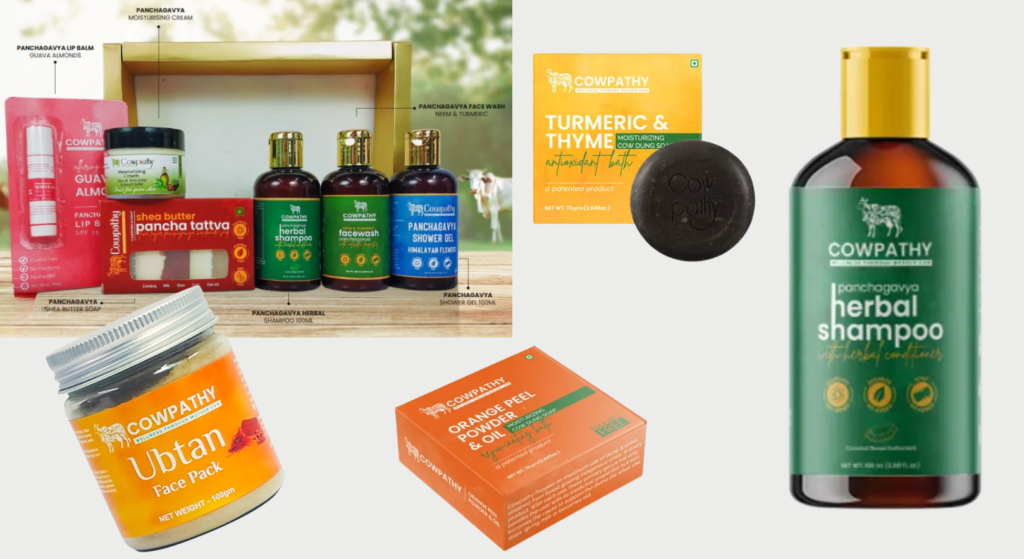
One thing I know from my many years in India is that the quality of the toiletries there is as excellent as the food. When I bought a joblot of Cowpathy products from an Indian supplier on eBay, I was expecting something that smelled of horror. Cowpathy is the name given to products that are made from Panchagavya.
And you know what? They smell GREAT! Because of the texture of the soap, it works amazingly well as an exfoliator. The shampoo is really potent; it smells very medicinal and leaves the hair so shiny. It’s quite unlike anything else I have ever used. Just don’t expect a large amount of lather. What I doubt, though, is that these products retain any active probiotic content, as they will have been exposed to a lot of heat during their manufacture.
The “Cowpathy Care” company website lists a whole range of cowpathy products, including toothpaste for the brave. This link will open in a new window: Cowpathy Care Company
Panchgavya and cow products: A trail for the holy grail
“…Integration of cowpathy (Govaidyak) in traditional Indian systems of medicine has been natural, based on their common dravyagunavigyan. But if its integration with conventional medicine is contemplated, we will need a better understanding of the ingredients of cow products, their pharmacokinetics, pharmacodynamics, and therapeutic ratio. A rational beginning can be made by data collection of experiential and anecdotal responses. A meticulous analysis of the database of panchgavya and other cow products should look for temporal relationships, biological plausibility, and translational potential before embarking on state-of-the-art experimental and clinical studies for selected indications…”
More here: https://www.ncbi.nlm.nih.gov/pmc/articles/PMC5884179/

Experiments similar to Pavlov’s dogs were used to determine whether bacteria learn,
eg express conditional reflex responses, this was foind to be true.
However, what was more surprising is that these learning may get passed on genetically because it was discovered bacteria also have sex, not often and all bacteria do this but occasionally they exchange DNA.
I would like to suggest the way the cream application on your lower back may obtain access into your gut would be via copulation with your own surface biome bacteria, which then carry their genetic information on as the new mixed bred baby gets a pass to the inside.
It’s just a hunch.🤣
Great..i’m being humped by bacteria.