Relational Dynamics
Amongst many other factors, relational dynamics are shaped by the interplay between Rules, Value, and Truth, the conditions placed upon behaviour, the perceived worth of contribution, and the authenticity of identity within the relationship.
Every interaction (whether personal, professional, or social) tends to be conditional, transactional, or performative, and our behaviour shifts depending on context, power, agency, and emotional state. This simple model helps illuminate not only how relationships function externally, but also how individuals negotiate belonging, worth, and authenticity internally.
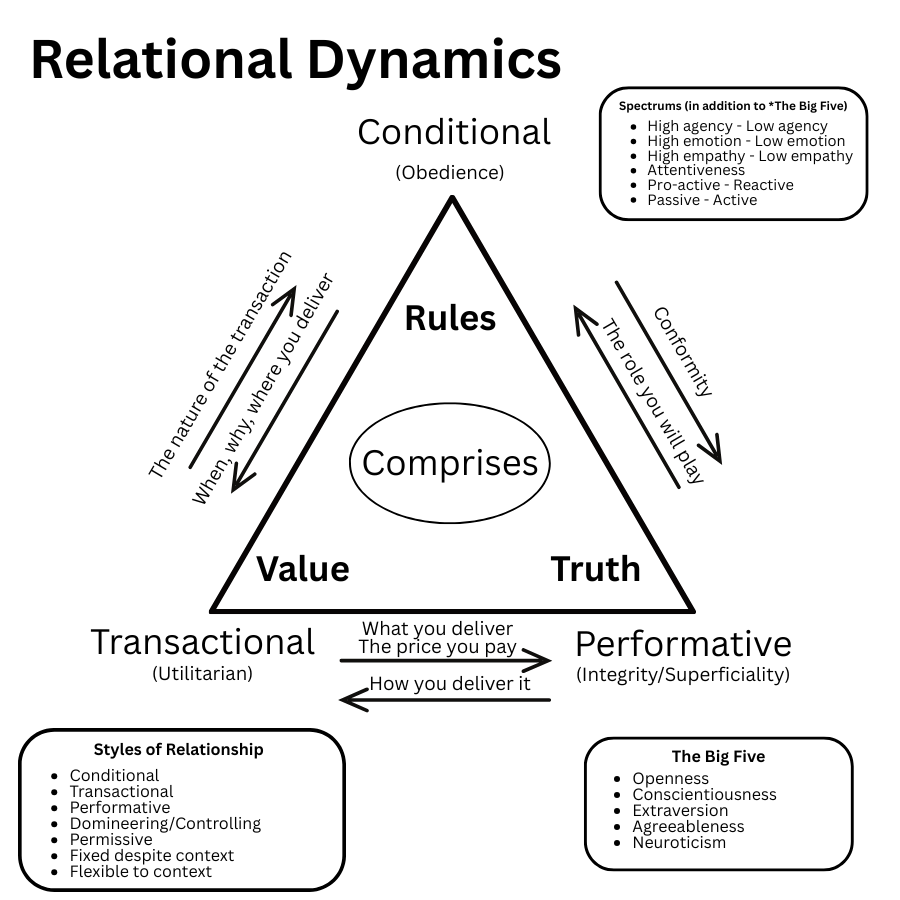
This model outlines how different relational styles emerge through the interaction of Rules, Value, and Truth. Every relationship - personal, professional, or therapeutic - contains a mixture of these three forces. The way they are prioritised shapes the nature of behaviour and expectation between people.
Rules (Conditional / Obedience)
This reflects the boundaries, expectations, norms, and implicit “shoulds” of the relationship. In highly conditional dynamics, acceptance and inclusion are contingent upon compliance. This is where permission, approval, and recognition are earned through correct behaviour.
Key question: “What must I (or you) be or do in order to belong here?”
Value (Transactional / Utilitarian)
This refers to usefulness, contribution, and exchange. Relationships leaning toward value are structured around benefit, cost, and reciprocity. People negotiate their worth by providing something of measurable gain, i.e. skills, support, resources, attention, and emotional labour.
Key question: “What am I (or you) giving, and what am I (or you) getting in return?”
Truth (Performative / Integrity vs Superficiality)
This represents authenticity, honesty, identity, and alignment with one’s real self. In performative relationships, there is pressure to enact a certain identity or role, one that may or may not reflect genuine inner experience. At healthy levels, this is integrity; at unhealthy levels, it becomes a mask.
Key question: “Who am I (or, who are you) being in this relationship, and is it real?”
Interpersonal Style Spectrums
| Interpersonal Style Spectrum | Range |
|---|---|
| Agency | High agency ↔ Low agency |
| Emotionality | High emotion ↔ Low emotion |
| Empathy | High empathy ↔ Low empathy |
| Attentiveness | Variable attentional engagement |
| Responsiveness | Proactive ↔ Reactive |
| Activity | Passive ↔ Active |
These variables determine how someone shows up in a relational field and whether they remain adaptive or rigid under social pressure.
Styles of Relationship
Different patterns form depending on which elements dominate:
- Conditional
- Transactional
- Performative
- Domineering / Controlling
- Permissive
- Fixed regardless of context
- Flexible to context
No single style is inherently “good” or “bad”, but misalignment creates friction. For example, a transactional person paired with a truth-authenticity person often results in misunderstanding: one is negotiating value while the other is negotiating identity.
This framework can be used to explore:
- Parenting dynamics
- Romantic relationships
- Workplace culture
- Client–practitioner relationships
- Power hierarchies
- Social belonging and rejection
- Boundary setting
- Authentic communication
A healthy relationship tends to be one where:
- rules are clear but not oppressive
- value is reciprocated but not commodified
- truth is expressed without punishment or performance pressure
When these are balanced, relationships become resilient, adaptive, respectful, and conducive to mutual psychological safety.