The Middle Pillar Meditation
An Overview of Structure, Method, and Purpose
The Middle Pillar meditation is a central practice within Western Hermetic Qabalah, commonly associated with the Golden Dawn tradition and popularised through the writings of Israel Regardie.
Although frequently presented today as a general “energy exercise,” its original function is more precise: it is an embodied learning method designed to internalise the symbolic architecture of the Tree of Life through structured imagination, vocal or subvocal intonation, and disciplined attention.
In this sense, it is less a passive contemplative exercise and more a method of constructing an organised inner reference system, i.e. one that links metaphysical concepts to somatic location, sensory vividness, and repeated experiential rehearsal.
I want to explain the Middle Pillar meditation as a pedagogical technology: a way of turning abstract correspondences into stable experiential knowledge. Here I will clarify the underlying logic of the practice (why it is structured as it is), the practical mechanics (how it is performed), and the developmental aims (what it is for over time), while distinguishing it carefully from superficially similar systems such as chakras. I must confess to no small amount of cringe when I see NLP trainers teaching the middle pillar on NLP trainings as an “energy exercise” (yes, really) without any understanding of it at all.
The Golden Dawn Context
Ritual as Instructional Design
The Hermetic Order of the Golden Dawn functioned primarily as a teaching order. Its ceremonial structure was not merely decorative: ritual, scripted dialogue, spatial movement, and costume were engineered to convey difficult philosophical ideas in an experiential form. Abstract metaphysical claims (about emanation, polarity, mediation, and manifestation) were “staged” so that they could be learned through repetition, participation, and gradual familiarity rather than through intellectual study alone.
This instructional strategy matters because it explains why an exercise like the Middle Pillar exists. It is essentially a condensed internal analogue of temple training: rather than learning the Tree of Life only as an external diagram, the practitioner learns it as a lived and embodied experience, repeatedly constructed within the field of bodily awareness. The meditation operates as a bridge between symbolic theory and embodied comprehension.
Why Embodiment Matters
From Diagram to Internal Reference System
A recurring problem in any abstract system is the gap between conceptual description and lived understanding. One can memorise correspondences, names, positions, colours, divine names, without any felt sense of their meaning. The Middle Pillar addresses this by making the Tree of Life (or at least its central axis) into a somatic map. Each locus is anchored to a region of the body, and that region becomes the site where symbolic attributes are repeatedly imagined, contemplated, and stabilised.
This is not “symbolism for its own sake.” It is a method of training attention. Over time, the practitioner builds a robust set of associations in which an abstract principle is no longer merely thought about; it is recognised as a structured experience, something that can be evoked, maintained, and integrated.
Not Chakras: Similarities, Differences, and a Key Technical Point
Because the Middle Pillar uses bodily locations, it is often casually equated with chakra practice. This is a category error, and to be frank, it’s hopeless trying to get the halfwits to understand this. The chakra systems of South Asian traditions have distinct historical development, doctrinal frameworks, and practical aims. Although both systems employ “centres” aligned along the body, the meanings and operational assumptions differ.
A key technical distinction is also methodological: in the Middle Pillar, the practitioner is not primarily attempting to imagine an object placed inside the body (for example, a “ball of light” inserted into the head). Instead, the bodily region itself is experienced as transformed by the attribution. The head becomes luminous; the throat becomes resonant; the central torso becomes integrative; the pelvic region becomes foundational; the feet become grounding. This subtle shift, from inserting an imagined object to transforming the felt quality of a region, often makes the practice substantially more effective.
The Five Centres of the Middle Pillar
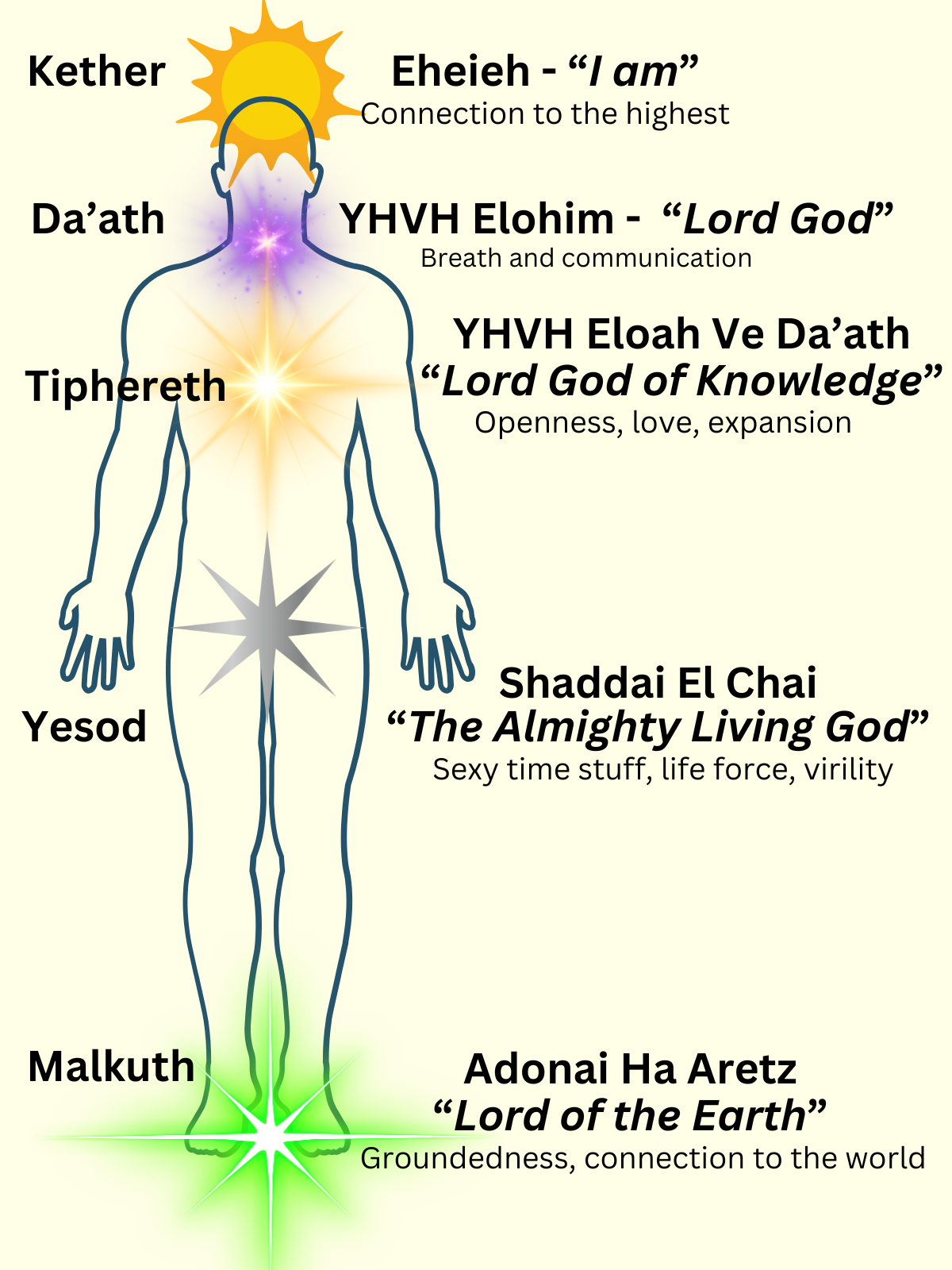
The classic Middle Pillar sequence builds five loci along the body’s central axis. These correspond to Kether, Daath, Tiphereth, Yesod, and Malkuth. The practice usually begins with a simple, uniform colour (often brilliant white) to stabilise basic imagery, and later introduces colour scales according to the tradition or the practitioner’s chosen correspondences.
Kether (Crown)
Kether is located at the crown of the head and symbolises pure being or existence prior to differentiation. The head (or crown region) is experienced as radiant, brilliant, expansive, and illuminating. In many presentations of the practice, the divine name associated with Kether is intoned in a sustained manner.
The manner of intonation varies: some vocalise aloud, some subvocalise internally, and some attempt to experience the sound as if it is resonating from beyond the self, as though the universe itself is “voicing” it. The latter approach can shift the phenomenology from personal effort to transpersonal resonance, which many practitioners regard as closer to the intended effect.
Daath (The Hidden Sphere; Threshold of Knowing)
Daath is commonly placed at the throat and is treated as a “hidden” or liminal sphere rather than one of the fully manifest ten. In practical terms, it functions as a threshold: the interface between undifferentiated being and articulated knowing.
Its location at the throat symbolises expression, articulation, and the emergence of structure through language. The throat region is experienced as subtly luminous or vibratory, often with a distinct sense of “resonance” that mirrors the conceptual role of Daath as mediation between levels.
Tiphereth (Beauty; Integration and Sacrifice)
Tiphereth is located in the central torso region (variously aligned with solar plexus or heart area). In the Middle Pillar, it is typically treated as central and balancing: the harmonising sphere that mediates above and below.
Symbolically, it is associated with beauty, equilibrium, integration, and, within many Western esoteric readings, sacrifice in the sense of self-transcendence and ethical alignment with a greater good.
Colour attributions here commonly include gold, red, or rose-gold, depending on the colour scale in use. The experiential aim is not simply “warmth” or “glow,” but a recognisable quality of centredness and coherent integration.
Yesod (Foundation; Imagination and Patterning)
Yesod is located in the pelvic or genital region and functions as a foundational matrix: the level through which images, memory traces, and organising patterns shape experience before it becomes overt action. In psychological terms, this can be framed as the structuring layer of imagination and representation, the interface where inner pattern becomes predisposition, and predisposition becomes behaviour.
Colour attributions frequently include violet or purple. Practically, the Yesod locus is cultivated as stable, coherent, and connected to the central axis rather than diffuse or disconnected.
Malkuth (Kingdom; Grounding and Embodiment)
Malkuth is placed at the feet and represents manifestation: the reality of embodiment, physical life, and engagement with the material world. Its inclusion at the feet is not arbitrary. It ensures the practice remains grounded rather than remaining a purely “upward” or abstract orientation. The feet become the site of stability and contact with the world, reinforcing the idea that spiritual or symbolic work is ultimately integrated through embodied existence.
Procedure: Building, Maintaining, and Linking the Centres
The Middle Pillar is typically performed by constructing each locus in sequence while maintaining the previous loci. In practice, this often means:
- Establishing Kether as radiant luminosity at the crown and sustaining it.
- Drawing a shaft or current of light down the central axis to the throat and establishing Daath, while keeping Kether active.
- Continuing the current to the central torso and establishing Tiphereth, maintaining the upper centres.
- Continuing to the pelvic region and establishing Yesod.
- Continuing to the feet and establishing Malkuth.
Throughout, divine names may be vibrated with rhythmic repetition. The practical point is not “correct pronunciation” in a scholastic sense (Western lodge pronunciations often function as conventional forms rather than linguistic reconstructions). The functional aims are resonance, attentional steadiness, and consistency of internal structure.
Circulation: The Integrative Loop
After the five loci are established, many versions of the Middle Pillar include a circulation phase in which the current is imagined to flow down through the centres, out through the feet, up around the exterior of the body, and back to the crown, thus forming a continuous loop. This can be interpreted as an integrative operation: it connects “above” and “below,” internal axis and external boundary, and unifies the constructed structure into a single coherent field.
Practically, this stage often shifts the experience from “placing centres” to “living inside a structured flow,” which can produce a distinctive phenomenology: stability, clarity, subtle energisation, and a sense of internal alignment.
Developmental Aims: Why Practice It?
A common question is: What is the point of vibrating names and imagining light? Within the Golden Dawn framework, the point is the gradual construction of a working, embodied knowledge of the Tree of Life. Each locus is not merely a spot of light; it is a site where attributes are contemplated, rehearsed, and stabilised. Over time, the practice becomes an internal scaffold for understanding the system as a whole.
This also explains why the early stages can feel unremarkable. The Middle Pillar is a cumulative discipline. Its effects, when they emerge, tend to be structural rather than dramatic: changes in the stability of attention, clarity of inner organisation, and the capacity to reliably evoke specific qualities. In that sense, it differs from meditation styles aimed primarily at sedation, blankness, or passive absorption.
Practical Accelerators: Sensory Aids and Training Wheels
Traditional presentations sometimes recommend sensory supports during early practice to help establish vividness and bodily localisation. These can include:
- Temporary tactile anchors (e.g., mentholated balm applied to the loci) to strengthen localisation through sensation.
- Visual cues (coloured discs or markings) to reinforce colour attribution and spatial placement.
- Mirror practice to stabilise the mapping of loci onto the body’s midline and improve consistency.
These aids are best treated as scaffolding rather than permanent requirements. Their purpose is to accelerate the formation of stable internal representations. Once the practitioner can evoke the loci clearly without external supports, the aids can be discontinued.
Adaptation and Substitution: Retaining Structure While Changing Language
Although rooted in a Judaic-Hermetic symbolic framework, the Middle Pillar’s effectiveness depends chiefly on structure rather than theology. In principle, the same architecture can be retained while substituting names or conceptual attributions that are more meaningful within a practitioner’s own paradigm, provided that the relational logic of the axis remains consistent. What matters is the disciplined construction of a coherent internal structure, not the particular vocabulary used to invoke it.
This structural adaptability partly explains why the practice has migrated into various modern contexts. However, such migrations can reduce the practice to a generic “energy loop” if the deeper pedagogical intent, the slow internalisation of symbolic architecture, is lost.
The Middle Pillar meditation is best understood as an embodied learning system: a disciplined method for internalising the central axis of the Tree of Life through imagination, resonance, and structured attention. It is neither a chakra practice nor merely a relaxation routine. Its aim is the gradual transformation of abstract metaphysical ideas into stable experiential knowledge – an inner reference framework that can support further study, ritual work, and psychological integration. Its value is cumulative, and its distinctive effects tend to emerge through consistency rather than immediacy.