The Hermit Archetype
Wisdom, Withdrawal, and Generative Insight in Qabalah and Tarot
The Hermit is among the most frequently misunderstood archetypes within Western esoteric symbolism. Commonly reduced in popular tarot literature to themes of isolation, introversion, or retreat from society, the archetype in fact encodes a far more complex philosophical position. Within Hermetic Qabalah and the Tarot tradition (particularly as expressed through Crowley’s Thoth deck), the Hermit represents a specific mode of wisdom: one that withdraws from reactive engagement while remaining actively generative and ethically oriented toward the world.
In this article I want to attempt a detailed examination of the Hermit archetype across Qabalistic, mythological, and psychological contexts. Rather than treating the card as merely a tool for fortune-telling, it is approached here as a symbolic compression of multiple intellectual traditions concerned with wisdom, fertility of insight, responsibility, and restraint. Frankly, divination and fortune-telling are just nonsense. It’s wishful thinking dressed up as mysticism and occultism.

Qabalistic Attribution: The Path Between Mercy and Beauty
In the Hermetic Tree of Life, the Hermit corresponds to the path connecting Chesed (Mercy) and Tiphereth (Beauty). This positioning is significant. Chesed represents expansive authority, benevolence, and structured order, while Tiphereth functions as the centre of balance, integration, and ethical coherence. The path between them concerns the disciplined transmission of wisdom from a position of authority into a harmonised, humane expression.
The Hermit is thus not an escape from responsibility but rather is a refinement of it. The archetype governs how wisdom is internalised, clarified, and then offered without coercion. It is the difference between imposing order and illuminating understanding.
The Hebrew Letter Yod: Potential and the Hand
The Hermit is attributed to the Hebrew letter Yod. In Qabalistic symbolism, Yod is associated with the hand, not as a literal linguistic translation, but as a symbolic function (“hand” in Hebrew is “yad”, not “yod”). It represents the seed point, the smallest mark from which all other letters emerge, and by extension, all forms.
Yod signifies potential prior to expansion. It is the concentrated origin of creative action. This attribution aligns the Hermit with generativity rather than negation: the capacity to bring something into being without external prompting or reactive engagement.
Withdrawal and the Paradox of Guidance
One of the central paradoxes of the Hermit archetype is the coexistence of withdrawal and guidance. The Hermit is often depicted as a solitary figure, cloaked and turned away, yet holding a lantern that illuminates the path for others. This image captures a critical distinction: withdrawal from emotional reactivity is not the same as withdrawal from ethical responsibility.
Wisdom, in this framework, does not require lamentation or performative outrage. The Hermit does not disengage because they do not care; rather, they disengage from unproductive emotional entanglement to act more effectively. This distinction mirrors professional contexts such as emergency medicine or frontline care, where emotional collapse would impede rather than enhance compassionate action.
The Lantern and the Sun: Internal Illumination
In the Thoth Tarot depiction, the lantern carried by the Hermit contains not a candle but the Sun. This is a crucial symbolic departure from more common tarot imagery. The Sun represents the source of life, vitality, and generative power. Placing it within the lantern implies that illumination does not come from external doctrine or authority but from an internalised, stable source of insight.
The Hermit does not shine the light outward indiscriminately. The lantern illuminates the path ahead, offering visibility without compulsion. Those who follow do so voluntarily. This reinforces the archetype’s ethical stance: wisdom offers; it does not impose.
Fertility Without Reproduction: The Orphic Egg and Virgo Symbolism
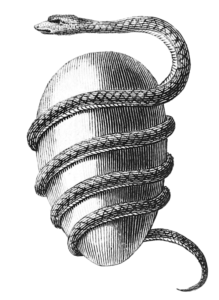
Several lesser-noticed symbols on the Hermit card reinforce its generative theme. The presence of wheat links the archetype to Virgo, traditionally associated with fertility, harvest, and discernment. Yet this fertility is not primarily sexual or reproductive. It is productive rather than procreative.
The Orphic Egg (an ancient Greek symbol of primordial creation) appears as a further layer of meaning. The Orphic Egg represents emergence without polarity: creation arising from itself rather than from the union of opposites. In biological terms, this aligns with the concept of parthenogenesis, the capacity to generate offspring without sexual reproduction.
Symbolically, this frames the Hermit as one who generates insight from accumulated understanding, reflection, and lived experience, rather than from reactive opposition or external validation.
The Spermatozoon and Ancient Models of Creation
Another frequently overlooked detail in the Thoth Hermit card is the stylised spermatozoon. In pre-modern biological models, the sperm was believed to contain a fully formed miniature human, with the womb functioning as a nutritive environment rather than a co-creative partner. While biologically incorrect, this belief is symbolically relevant.
Within the archetypal logic of the Hermit, the spermatozoon represents the idea that the generative principle already contains its outcome. Creation unfolds from what is already latent. Applied psychologically, this suggests that insight is drawn out from within, not assembled from external fragments.
Osiris, the Eastward Gaze, and the Solar Path
The Hermit’s profile orientation (turned away from the observer) echoes mythic representations of Osiris on his eastward journey. East, in esoteric architecture, is the direction of the rising Sun and the source of illumination. For precisely this reason, temples, lodges, and ritual spaces traditionally orient toward this direction.
The Hermit’s movement toward the East symbolises the continual pursuit of wisdom rather than a fixation on status or recognition. The light carried is not a trophy of attainment but a companion on an ongoing journey.
The Risk of Imbalance: When the Hermit Becomes Ego
A significant warning is embedded within the Hermit archetype. When developed in isolation from the rest of the Tree of Life, its emphasis on “inner truth” can degenerate into narcissism or post-truth subjectivism. Declaring one’s personal perspective as the ultimate truth, absent discipline, education, or ethical integration, is not wisdom but distortion.
The Hermit assumes prior development: intellectual rigour, emotional maturity, ethical grounding, and lived experience. Without these, the archetype collapses into performative withdrawal or self-appointed authority. This explains the modern proliferation of self-styled gurus and coaches whose confidence exceeds their depth.
The True Function of the Hermit
At its highest expression, the Hermit archetype describes a mode of being in which wisdom is cultivated inwardly and offered outwardly without force. It is neither disengaged nor reactive. It does not seek validation through applause, nor does it require followers to justify its existence.
The Hermit holds the light, walks the path, and allows others to see by example. Whether they follow is not the Hermit’s concern.
The Hermit is not the archetype of retreat but of disciplined restraint. It represents the capacity to generate insight without compulsion, to act without outrage, and to illuminate without coercion. Within Qabalah and Tarot, it stands as a corrective to both blind conformity and egoic self-assertion.
Properly understood, the Hermit is neither aloof nor passive. It is the archetype of quiet authority, fertile wisdom, and ethical presence, one that remains engaged with the world while refusing to be consumed by it.