Projection, Discernment, and the Preparation for Ascent
Here we examine two closely related paths on the Hermetic Tree of Life: the 29th Path (Qoph, The Moon) and the 31st Path (Shin, The Aeon / Last Judgement). Although often treated in isolation or reduced to tarot meanings, these paths are best understood as part of a coherent developmental sequence concerned with the maturation of the human psyche prior to higher initiatory or spiritual integration.

Rather than describing abstract mystical states, these paths address the concrete psychological and ethical work required to move beyond naïve subjectivity, superstition, projection, and status-seeking. They are concerned with the world of ordinary human functioning: how perception is distorted, how meaning is constructed, and how a sense of inner stability and continuity is formed before any genuine “higher” work can occur.
Context: The Lower Tree and the World of Human Development
 Both the 29th and 31st paths originate in Malkuth, the sphere of manifestation and physical existence. Malkuth does not merely represent “the Earth” in a simplistic sense but the totality of lived material reality: the body, work, health, finances, home, and the practical conditions of daily life. In developmental terms, this is the world that must first be stabilised.
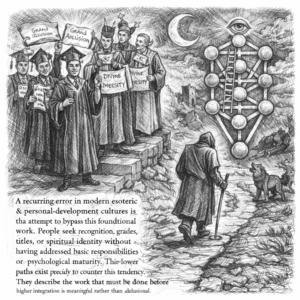
A recurring error in modern esoteric and personal-development cultures is the attempt to bypass this foundational work. People seek recognition, grades, titles, or spiritual identity without having addressed basic responsibilities or psychological maturity. The lower paths exist precisely to counter this tendency. They describe the work that must be done before higher integration is meaningful rather than delusional.
The 31st Path (Shin)
Fire, Spirit, and the Hearth of Belonging
The 31st Path connects Malkuth to Hod and is attributed to the Hebrew letter Shin. In Qabalistic symbolism, Shin carries a double attribution: fire and spirit. It is also traditionally associated with the image of the tooth, an apparently mundane detail that carries considerable symbolic weight.
Teeth are unique in the human body. Unlike most tissues, they do not regenerate over time. They persist unchanged throughout life and often remain identifiable long after death. For this reason, Shin becomes a fitting symbol for continuity and endurance, and by extension, the idea of an “immortal” or persistent aspect of identity.
Psychologically, this path concerns the formation of inner continuity: the sense that one exists as the same self across time, change, and adversity. Without this continuity, intellectual development becomes brittle, and spiritual aspiration becomes compensatory rather than integrative.
The Hearth Fire: Home, Belonging, and Emotional Baseline
An essential image associated with this path is that of the hearth fire. This is not merely a romantic or nostalgic symbol. The hearth represents warmth, safety, belonging, and emotional regulation. It is the psychological experience of having a “home”, whether literal or symbolic.
Where this is absent, i.e., through neglect, instability, or early emotional deprivation, individuals often seek compensation through status, recognition, ideology, or identity inflation. Much narcissistic striving can be understood as an attempt to replace the missing hearth with external validation.
The work of the 31st Path is therefore preparatory. It involves establishing a baseline of emotional security and continuity so that intellectual development (Hod) does not become disconnected, elitist, or inhuman (anyone who has spent any length of time in a large higher education organisation will be familiar with the “intellectual bully” that finds a home there). Knowledge pursued without warmth becomes alienating; learning pursued without belonging becomes brittle.
Hod and the Will to Know
Importantly, this path is not about knowledge itself but about the will to knowledge. Hod represents communication, learning, language, and analysis. The 31st Path concerns the motivation to engage with these faculties responsibly. It is the difference between accumulating information and cultivating understanding.
Without the stabilising influence of the hearth fire, Hod degenerates into pedantry, abstraction, or social detachment. The archetype of the disconnected intellectual—brilliant yet inhuman— illustrates what happens when this path is unbalanced.
The 29th Path (Qoph)
The Moon, Projection, and Navigating Uncertainty
 The 29th Path connects Malkuth to Netzach and is attributed to Qoph and the Tarot card of The Moon. This path is among the most psychologically demanding on the Tree, as it concerns perception under conditions of uncertainty.
The Moon does not generate its own light. It reflects sunlight, distorting it across surfaces and creating ambiguity, shadow, and illusion. In symbolic terms, this is the realm of the unconscious, imagination, instinct, fear, and projection.
The Midnight Forest: Perception Without Sight
The initiatory image of this path is that of moving through a forest at midnight. Vision is unreliable or unavailable. One must navigate using partial sensory information, particularly intuition, and feedback from the environment. Some threats are real; others are imagined. The difficulty lies in distinguishing between intuition (good) and superstition (not good).
This path addresses a core human problem: the tendency to mistake projection for perception. Fears, beliefs, assumptions, and emotional reactions are unconsciously projected onto the world and then treated as objective facts.
Historically, this has manifested as superstition, witch hunts, and moral panics. In modern contexts, it appears as ideological contagion, online outrage cycles, and the collapse of the distinction between belief and evidence in a “post-truth” culture.
Projection Versus Reality
The work of the 29th Path is learning to differentiate between:
- What is directly observed
- What is inferred
- What is imagined
- What is emotionally desired
Failure to make these distinctions leads to cognitive rigidity and collective delusion. Individuals become unable to tolerate ambiguity and instead enforce subjective interpretations as moral or factual absolutes.
This path, therefore, demands humility, scepticism, and self-examination. It requires the practitioner to recognise their own capacity for distortion and to develop the discipline to pause before reacting.
Balancing Hod and Netzach: Intellect and Creativity
The two paths examined here terminate in Hod and Netzach, respectively. Hod represents structured intellect, language, and analysis. Netzach represents creativity, emotion, desire, and aesthetic expression. The lower work of Malkuth prepares the ground; the 31st and 29th paths ensure that intellect and creativity emerge in balance rather than in rivalry or excess.
An overdeveloped Hod produces cold rationalism and detachment. An overdeveloped Netzach produces emotionalism, impulsivity, and projection. These paths exist to prevent either extreme by refining the foundations from which both arise.
Preparation, Not Transcendence
Neither of these paths represents spiritual transcendence. They represent preparation. They concern becoming a stable, grounded, discerning human being before attempting to become “more than human”.
Attempts to bypass this work often result in spiritual narcissism: the adoption of elevated language and identity without corresponding psychological maturity – it becomes compensatory and performative. The Tree of Life is unforgiving in this respect. What is not integrated below will reappear as distortion above.
The 29th and 31st paths describe the difficult, often unglamorous work of becoming fit for further development. They demand stability in the material world, warmth and continuity in emotional life, discipline in perception, and humility in interpretation.
Taken seriously, these paths act as safeguards against delusion, projection, and ego inflation. They ensure that intellect is humane, creativity is grounded, and aspiration is earned. Only on this basis does further ascent on the Tree of Life become meaningful rather than merely symbolic.