Mental Spatial Structure and the Logic of Ancient Change Work
Across cultures and historical periods, human beings have repeatedly externalised inner distress, conflict, and suffering into forms that appear autonomous, agentic, and spatially located. This process, commonly referred to as anthropomorphisation or personification, is not merely a poetic or symbolic tendency, but a fundamental linguistic and cognitive operation.
The present article examines how ancient magical and ritual frameworks can be understood as sophisticated early technologies for working with personified psychological material, and how their underlying spatial logic remains relevant to contemporary therapeutic practice.
Anthropomorphisation and the Externalisation of Experience
Everyday psychological experience frequently involves the treatment of internal states as if they were separate entities. People speak of being “haunted” by memories, “attacked” by anxiety, or “controlled” by depression. Linguistically and phenomenologically, such experiences are placed outside the self, occupying a quasi-independent existence. Once externalised in this way, the experience enters a relational dynamic: it can be avoided, fought, negotiated with, feared, or endured.
This separation has important consequences. When a distressing experience is perceived as external and autonomous, it appears to exist in three-dimensional space relative to the individual. The person is no longer simply experiencing a feeling; they are in a relationship with something that confronts them. Modern psychology often describes this process in terms of dissociation or maladaptive coping, but ancient systems approached the same phenomenon using religious and magical language.
Historical Frameworks and Cultural Lexicons
Ancient grimoires and ritual traditions did not conceptualise psychological distress in neurological or psychiatric terms. Instead, they framed experience through the dominant metaphors of their time: spirits, demons, angels, gods, and cosmic battles between opposing forces. These metaphors should not be dismissed as primitive misunderstandings. Rather, they functioned as culturally coherent models for engaging with internal phenomena that felt alien, intrusive, or overwhelming.
Just as contemporary discourse increasingly describes the mind using computational metaphors, notably: programming, clearing, wiring, resetting, the ancient systems reflected the technological and symbolic vocabulary available to them. The mechanisms, however, remain strikingly consistent: create separation, establish safety, access resources, engage the problem from a position of strength, and restore order.
The Circle: Delineation of Self and Experience
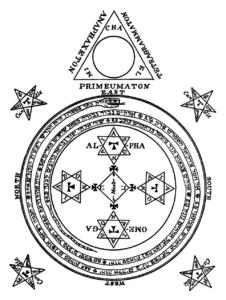
Central to many ritual systems is the construction of a circle. Psychologically, the circle functions as a boundary that clearly distinguishes the individual from the experience being addressed. The circle asserts a critical principle: the person is not the event, and the feeling is not the self.
This spatial demarcation creates a protected working environment. Within the circle, the individual is contained, centred, and separate from the problem. In modern terms, this parallels the creation of a therapeutic frame or a neutral observing position, from which experience can be examined without being overwhelming.
The Triangle of Art and the Location of the Problem
Outside the circle lies the triangle of art. This triangle represents the natural spatial location where the personified problem appears relative to the individual. By deliberately placing the entity within the triangle, the individual brings the experience into conscious awareness while maintaining separation and control.
This act reverses the usual dynamic in which the problem intrudes unpredictably into awareness. Instead, the individual summons it under structured conditions, within a defined spatial and relational framework.
Banishing and the Necessity of State Change
Before engagement can occur, ancient systems emphasised banishing or clearing rituals. These practices were designed to induce a neutral or altered state of consciousness, one that is not contaminated by the emotional state of the problem itself. Attempting to resolve an issue from within the same psychological state that sustains it is widely recognised as ineffective.
Importantly, banishing is not a superficial or rapid process. In traditional settings, it could take hours or longer, especially in group contexts. The emphasis was on ensuring that all participants were fully shifted into an appropriate internal state before proceeding. This mirrors modern understandings of state-dependent cognition and emotional regulation.
Invocation of Resources and Psychological Fortification
Once the circle is clear, resources are invoked. In magical traditions, these may take the form of archangels, spirits, or symbolic allies. Psychologically, they function as representations of internal strengths, competencies, values, and supportive identities.
The preparation for invocation is often extensive. It may involve education, training, rehearsal, and the gradual cultivation of skills or perspectives. This stage highlights a critical balance: focusing exclusively on problems is insufficient, but so too is focusing solely on positivity while ignoring difficulty. Effective change requires both resource development and direct engagement with the issue.
Respectful Engagement and Negotiation
When the personified experience is finally addressed, the stance taken is one of dignity and respect. Hatred, fear, or contempt are explicitly discouraged. The individual engages from a position of strength, not domination. This is a crucial ethical and psychological distinction.
Rather than attempting to annihilate or dismiss the problem, the individual negotiates with it. What does it need? What function has it served? What conditions would allow it to move to its proper place? These questions recognise that many persistent difficulties arise because something within the system is displaced or unmet.
License to Depart and Restoration of Order
Following negotiation, the entity is given a license to depart. This act reverses a common maladaptive pattern in which individuals attempt to suppress, distract from, or forcibly eliminate unwanted experiences. Instead, the experience is acknowledged, thanked for its service, and released.
Only after the entity has departed are thanks given to the invoked resources, and the closing banishing ritual performed. This restores psychological boundaries and prevents lingering entanglement with the altered state.
Chaos Magic, Laughter, and State Chaining
Later traditions, particularly chaos magic, stripped away much of the symbolic dogma while retaining the functional structure. Any symbol could be used, provided it achieved the intended psychological effect. Laughter, in particular, was identified as a powerful final banishing mechanism.
From a modern psychological perspective, this reflects deliberate state chaining: transitioning from intense focus to lightness, humour, or physical movement to stabilise the nervous system.
Ancient change work, when examined through a psychological lens, reveals a highly structured approach to working with personified internal experiences. Its emphasis on spatial organisation, state management, resource cultivation, respectful engagement, and orderly closure anticipates many principles now considered foundational in contemporary therapeutic practice.
Far from being obsolete, these models offer a rich conceptual framework for understanding how humans relate to their inner world and how lasting change may be facilitated through careful attention to space, state, and relationship.