Binah and Chokmah
Archetypal Masculine and Feminine, Religious Suppression, and Contemporary Gender Confusion
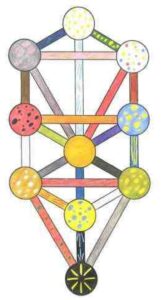
Here, we explore Binah and Chokmah, the archetypal feminine and masculine principles within the Hermetic Qabalistic Tree of Life, and examine how historical distortions of these archetypes may echo into contemporary cultural and psychological confusions surrounding gender, identity, and childhood development.
The argument I present here is not theological advocacy nor a sociopolitical polemic, but an archetypal and cultural analysis grounded in symbolic psychology, comparative religion, and developmental observation. I have tried to pack in as many big words as possible. It’s good for the SEO, apparently.
Keter and the Androgynous Source
Within the Hermetic Qabalistic model, all manifestation originates in Keter, the Crown. Keter represents the undifferentiated godhead: not male, not female, but containing both principles in perfect equilibrium. Masculine and feminine polarity emerges only with the first differentiation of unity, expressed as Chokmah (Wisdom) and Binah (Understanding).
It is crucial to emphasise that Chokmah and Binah are not “men” and “women” in a biological or sociological sense. They are archetypal principles (i.e., modes of ordering experience) through which human cultures, myths, and psychologies have articulated creativity, authority, containment, law, nurturance, and meaning.
Binah and Chokmah as Archetypal Principles
Chokmah represents dynamic, generative force: expansion, impulse, creative thrust, and the outpouring of potential. Binah, by contrast, represents form-giving intelligence: structure, limitation, gestation, containment, and comprehension. Together, they constitute the archetypal masculine and feminine, not as oppositional categories but as complementary necessities.
Importantly, these principles are not fixed or monolithic. Archetypes express themselves differently across cultural contexts and historical periods. Their symbolic expressions evolve, fragment, recombine, and sometimes become distorted.
Gods as Archetypes, Not Literal Entities
In this framework, gods are understood as archetypal condensations and expressions of meaning rather than literal supernatural beings. They are symbolic forms that transmit psychological and cultural information across generations.
Hindu cosmology provides a clear example: Shiva and Shakti function as archetypal masculine and feminine principles, yet appear through countless deities and mythic forms. These multiplicities do not contradict the archetype; they express its adaptability.
Christianity likewise presents multiple faces of Christ: the infant, the teacher, the rebel, the sacrificial victim, and the apocalyptic judge. Different denominations selectively emphasise different aspects, shaping collective psychology in markedly different ways.
The Suppression of the Archetypal Feminine in Christianity
A defining historical shift occurred in the institutionalisation of Christianity between the early centuries CE and the early mediaeval period. In contrast to many early pagan, Judaic and Gnostic traditions (which recognised both priests and priestesses), the emerging Catholic orthodoxy systematically removed the feminine from positions of symbolic authority.
The archetypal feminine was not entirely eliminated but was radically constrained. It survived almost exclusively in the figure of the Virgin Mary. Critically, Mary’s sanctity is defined by sexual absence. She is pure, immaculate, and non-threatening to the patriarchal order.
This reduction had profound cultural consequences. Where once feminine archetypes encompassed wisdom, ferocity, sexuality, protection, and authority, Western Christianity preserved only an idealised, desexualised maternal form.
Even in today’s modern churches, where women can serve as priests, they are “woman-priests” and crucially are not priestesses. They are merely the female embodiment of the patriarchal archetype.
Moral Asymmetry and Gendered Archetypes
This narrowing of the feminine archetype produced a stark moral asymmetry. Biblical male figures frequently display sexual licence, multiple partners, concubines and moral transgression, yet remain venerated. Female sexuality outside church-sanctioned marriage, by contrast, became synonymous with moral failure.
The archetypal benchmark for femininity became impossible: women were expected to emulate virgin motherhood. This symbolic contradiction has echoed through centuries of social regulation, shame, and moral control.
Modernity and the Medicalisation of Childhood
I regularly argue that contemporary society has replaced mythic and archetypal education with medical and pharmacological regulation. Behaviours once understood as developmental, eccentric, or situational are now routinely pathologised.
Childhood itself has become a diagnostic landscape. Emotional volatility, excess energy, defiance, or imaginative behaviour are increasingly interpreted through medical frameworks rather than developmental or symbolic ones.
This medicalisation is not neutral. It reflects cultural anxiety about deviation, unpredictability, and non-conformity. It is state-sanctioned control through medicine.
Archetypal Collapse and Contemporary Gender Confusion
This argument does not deny the reality of distress experienced by gender-dysphoric individuals. Rather, it asks a prior question: what archetypal models are young people rejecting?
When adolescents declare themselves “not masculine” or “not feminine”, the issue may not be identity itself but the impoverished and distorted archetypes available to them. Masculinity has been rhetorically collapsed into “toxicity”; femininity into historical oppression or sexual contradiction.
If the only available archetypes are awful caricatures, rejection becomes inevitable.
Comparative Archetypes: The Case of Kali
In contrast, traditions such as Hinduism preserve a wide spectrum of feminine archetypes. The goddess Kali exemplifies this richness: terrifying, protective, destructive, maternal, and liberatory.
Kali functions as a psychologically coherent archetype of the matriarch who confronts chaos and destroys inner demons on behalf of the individual. No Western Christian equivalent exists at comparable symbolic depth.
Archetypal Amnesia and Cultural Consequences
I propose that contemporary identity confusion – particularly among adolescents – cannot be understood solely through individual psychology or political ideology. It must also be examined as a symptom of archetypal erosion.
By dismantling masculine and feminine archetypes without replacing them with symbolically viable alternatives, modern culture has left young people without stable benchmarks for identity formation.
Restoring archetypal literacy does not require religious belief. It requires symbolic education: an understanding that identity develops through engagement with rich, plural, and non-reductive archetypal models.